A Bachelor of Science in Physics (B.Sc. physics) is a full-time undergraduate course which aims to teach students the fundamental principles of physics. It allows students to gain expertise in both classical and modern theories to understand, analyse and solve the physical phenomena around the world.
Blending the practical application with quantum physics, thermodynamics, electromagnetism and mechanics, B.Sc. offers a solid foundation for a lucrative future. Our blog gives an in-depth understanding of the course, required skills, top universities in the country, career scope, etc. Learn ahead.
What is B.Sc. Physics?
The B.Sc. physics is a three-year undergraduate programme which integrates a comprehensive understanding of core concepts, and modern theories and engages in practical research projects. Due to the intensive coaching, the students have excellent learning opportunities. If you have strong mathematical abilities, effective communication skills and laboratory expertise, a B.Sc. in physics is a great option. Below is a list of skills needed for this course.
- Analytical skills
- Laboratory skills
- Mathematics
- Critical thinking
- Data analysis
- Communication skills
- Attention to detail
- Problem-solving approach
K.R. Mangalam University: Top University for B.Sc. in Physics
Students thinking about pursuing a B.Sc. physics degree should be aware of the colleges and universities available in India. In Delhi and NCR region alone, there are more than 70 options. So it’s natural to get overwhelmed. However, K.R. Mangalam University is a top runner when it comes to holistic learning experience.
Located in the vibrant city of Gurgaon, KRMU offers various undergraduate and postgraduate courses. If you are a student looking for a top college to study B.Sc physics, this might be it. KRMU empowers students to excel academically and gives them hands-on practical exposure. Let’s learn more below.
Course Details
| Full Course Name |
Bachelor of Science in Physics (Hons.) |
| Course Type |
Undergraduate |
| Course Duration |
3 Years |
| Admission Eligibility Criteria |
10+2 or equivalent examination from any recognised board/ University + PCB/PCM as a mandatory course + Minimum 50% aggregate marks |
| Programme Fee Per Year |
Rs.90,000 |
| Average Salary |
6 LPA |
| Career Options |
Laboratory Technician, Statistical Investigator, Nanotechnologist, Radiologist Assistant, Technical Writer, Government Sector Scientist |
B.Sc. Physics Honours Syllabus
Year 01
| Semester I |
Semester II |
| Mathematical Physics-I |
Mathematical Physics-II |
| Electricity and Magnetism |
Mechanics |
| Electricity and Magnetism Lab |
Mechanics Lab |
| Value-Added Course |
Value-Added Course |
| Basic Instrumentation Skills |
Open Elective-I |
| Generic Elective I |
Physics Workshop Skill |
| Club/Society |
Generic Elective III |
|
Community Services |
Year 02
| Semester III |
Semester IV |
| Mathematical Physics-III |
Quantum Mechanics and Applications |
| Mathematical Physics III Lab |
Waves and Optics |
| Solid State Physics |
Waves and Optics Lab |
| Solid State Physics Lab |
Crystallography |
| Modern Physics |
Crystallography Lab |
| Modern Physics Lab |
Open Elective-III |
| Open Elective |
Basic IT Tools |
| Verbal Ability |
Communication & Personality Development |
| Evaluation of Summer Internship |
|
Year 03
| Semester V |
Semester VI |
| Thermodynamics and Statistical Mechanics |
Analog Systems and Applications |
| Digital Systems and Applications |
Analog Systems and Applications Lab |
| Digital Systems and Applications Lab |
Nuclear Physics |
| Classical Dynamics |
Electromagnetic Theory |
| Synthesis of Nanomaterials-I |
Atomic and Molecular Physics |
| Laser Fundamentals |
Discipline Specific Elective |
| Arithmetic Reasoning-III |
Discipline Specific Elective Lab |
|
Discipline Specific Elective |
Scope After B.Sc. in Physics
Thanks to the expanding tech landscape, the career scope for B.Sc. in physics graduates has been growing around the globe. It is a general misconception that the programme is limited to engineering. However, it opens up a wide spectrum of fields including Nuclear Physics, Geophysics, Biotechnology and more. Some popular job profiles are:
- Lab Technician
- Physicist
- Industrial Research Scientist
- Lab Supervisor
- Healthcare Technology Specialist
- Nanotechnologist
- Lecturer
- Radiation Oncologist
Conclusion
B.Sc. physics is an exciting undergraduate programme that emphasises the understanding of fundamental principles of the universe. This course helps in honing critical thinking, analytical and problem-solving skills. As there are so many top B.Sc. physics colleges in India, choosing the right place is important. This is why K.R. Mangalam University is a great option. Located in Gurugram, KRMU empowers students to navigate the complex world of science and technology with confidence and expertise. Start your journey today!
FAQs
What are the benefits of studying B.Sc. physics?
B.Sc. in physics is an undergraduate programme that opens up a variety of career opportunities for graduates. From technology and research to healthcare and education, this degree encompasses various fields.
What are the core B.Sc. in physics subjects covered in the curriculum?
The B.Sc. in physics programme covers subjects such as Mathematical Physics, Mechanics, Crystallography, Basic IT Tools, Arithmetic Reasoning, Electromagnetic Theory, etc.
Which is the best university for B.Sc. physics in Delhi-NCR?
India boasts several colleges and universities for undergraduate programmes, like B.Sc. physics. But K.R. Mangalam University in Gurugram is considered the best in the Delhi-NCR region.
What are some top recruiting companies for B.Sc. physics graduates?
Some top recruiting companies are the Asian Institute of Medical Sciences (AIIMS), Siemens Healthineers India, Analog Devices, Solar Industries India LLP, etc.




 13 Schools700+ Faculty Members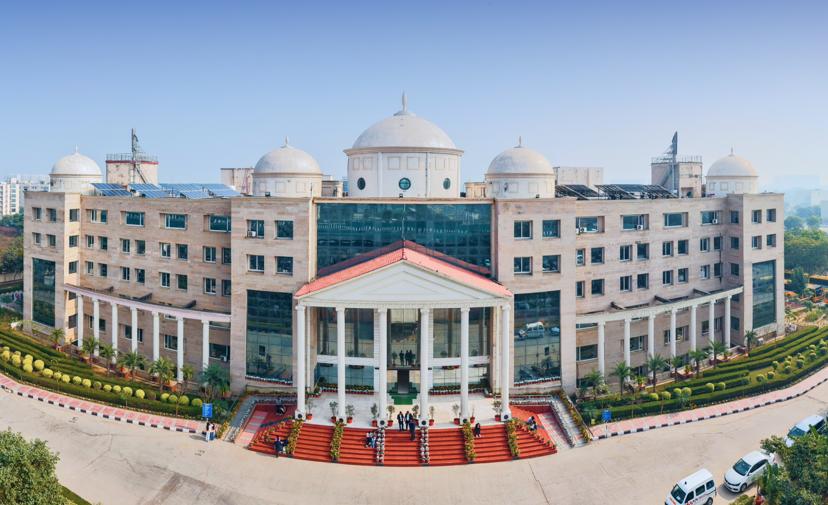













 13+Years of Educational Experience