Copy & Paste Below SCRIPT before the close of body tag
can i do mba after 12th​

How Can I Do MBA After 12th? Admission & Eligibility

September 2, 2025

Many students, right after completing class 12, ask themselves, “Can I do MBA after 12th?” The answer to this common question is ‘Yes’, but not in the traditional way. While a regular MBA programme is a postgraduate degree (which requires a bachelor’s qualification), students can choose an integrated MBA course right after passing class 12.

This integrated programme combines undergraduate and postgraduate studies, allowing students to start early, save time, and build strong management foundations. For ambitious learners aiming for corporate leadership or entrepreneurial success, this path is ideal.

If you are asking questions like “How can I do MBA after 12th?” or “After 12th MBA is possible?” This detailed guide will clear all your doubts.

What is an Integrated MBA?

An integrated MBA is a 5-year dual degree programme that merges a bachelor’s degree (like a BBA, BMS, or equivalent) with a Master of Business Administration (MBA).

Highlights of an Integrated MBA

  • Duration: 5 years (10 semesters)
  • Degree Awarded: UG + PG (BBA/MBA or similar combination)
  • Entry Level: After Class 12
  • Specialisations: Finance, Marketing, HR, International Business, Data Analytics, and more

This programme allows you to start your management journey right after passing your class 12, unlike a regular MBA that requires you to first complete a bachelor’s degree.

Also Read: List of all MBA Specialization Courses

How Can I Do MBA After 12th?

If you want to pursue an MBA after 12th, the only route is through an integrated programme. K.R. Mangalam University (KRMU) offers an integrated BBA+MBA with academic support of IBM.

What is the BBA-MBA Integrated Programme?

The BBA-MBA integrated programme is a comprehensive, fast-tracked route for students who aspire to build strong careers in business and management. It blends the core principles of business administration with advanced leadership and strategic skills, ensuring students are well-prepared for the dynamic corporate world. 

Graduates of this programme can pursue diverse roles such as Marketing Manager, Human Resource Specialist, Financial Analyst, Operations Leader, or Business Consultant. By saving an extra year of study and offering continuous exposure to real-world business practices, this dual-degree course gives students a distinct advantage.

Here are a few important details about the integrated BBA+MBA course offered by KRMU:

Duration 5 Years
Programme Fee / Year Rs. 2,30,000 (as of September 2, 2025)
Eligibility Passed 10+2 or equivalent examination from any recognised board/university with minimum 50% aggregate marks.

Curriculum and Syllabus:

YEAR 1
SEMESTER I SEMESTER II
  • Principles of Management
  • Financial Accounting and Reporting
  • Fundamentals of Marketing
  • Indian Knowledge System
  • Micro Economics
  • Business Mathematics
  • Cyber Law and Governance
  • Commercial Laws
  • Individual and Organisational Behaviour
  • Cost and Management Accounting
  • Open Elective I
  • Health and Fitness
  • Business Statistics
  • Economic Environment and Policy
  • MS Excel for Business
  • Decision Science Tools in Business by IBM


YEAR 2
SEMESTER III SEMESTER IV
  • Managing Contemporary Human Resources
  • Operations Management
  • Advanced Excel
  • Project Management
  • GST and E Filing
  • Business Sustainability, Governance and Ethics
  • Sales and Distribution Management
  • Written Communication and English language
  • Summer Internship / Research Project
  • Research Methodology For Business
  • Supply Chain and Logistics Management
  • Introduction to Power BI, Python and SQL
  • Introduction to Digital Marketing
  • Introduction to Financial Management
  • Entrepreneurship Development
  • Open Elective II


YEAR 3
SEMESTER V SEMESTER VI
  • Operations Research
  • Block chains and crypto currency (Major taught internally)
  • Managing big data (Major taught internally)
  • Summer Internship / Research Project
  • General Awareness for Business
  • Oral Business Communication
  • AI Tools for Business
  • Strategic Management
  • Creating intelligent machines (Machine Learning) by IBM
  • Global Business Operations
  • Negotiation
  • Business Ethics, Values & Corporate Governance
  • Enterprise Resource Management (Major taught internally)
  • Challenges of Business Environment


YEAR 4
SEMESTER VII SEMESTER VIII
  • Organisational Structure, Culture and Design
  • Predictive Analytics by IBM
  • Specialization I Elective II
  • Specialization II Elective I
  • Specialization II Elective III
  • Marketing Research
  • Specialization I Elective I
  • Specialization I Elective III
  • Specialization II Elective II
  • Capstone Project
  • Specialization I Elective V
  • Specialization I Elective VII
  • Specialization II Elective V
  • Specialization II Elective VII
  • Specialization I Elective IV
  • Specialization I Elective VI
  • Specialization II Elective IV
  • Specialization II Elective VI


YEAR 5
SEMESTER IX SEMESTER X
  • Summer Internship Project Report
  • Project Based Learning
  • Dissertation-I
  • Social Immersion
  • Employability Certification
  • Dissertation-II


MBA Course Eligibility After 12th

Since a direct MBA after 12th is not possible, here’s the integrated MBA eligibility criteria:

  • Completion of 10+2 or equivalent from a recognised board.
  • Minimum aggregate marks: 50%–60% (varies across colleges and universities).
  • Entrance exam qualification (IPMAT, NPAT, SET, CUET, or college-specific tests like KREE).

Best Integrated MBA Colleges in India

If you are looking for the best integrated MBA colleges in India, here are some reputed names:

  • K.R. Mangalam University, Gurgaon – Offers an Integrated BBA+MBA with academic support of IBM.
  • IIM Indore – Offers the 5-year Integrated Programme in Management (IPM).
  • IIM Rohtak – Another prestigious IPM programme with excellent placements.
  • NMIMS (Mumbai & Other Campuses) – Integrated MBA via NPAT entrance.
  • Symbiosis International University (Pune) – Offers BBA+MBA through SET exam.
  • Christ University (Bangalore) – Known for integrated management programmes.

Also Read: Integrated BBA+MBA with academic support of IBM

Is MBA After 12th Possible Without Entrance Exams?

Many private universities and colleges allow direct admission into integrated MBA programmes based on class 12 marks. However, the most reputed institutions (like KRMU, IIMs and NMIMS) conduct entrance exams.

So, while after 12th MBA is possible without an entrance exam, the best career prospects usually come from reputed colleges where exams are mandatory.

Advantages of Doing MBA After 12th

Starting an MBA journey immediately after school has many benefits:

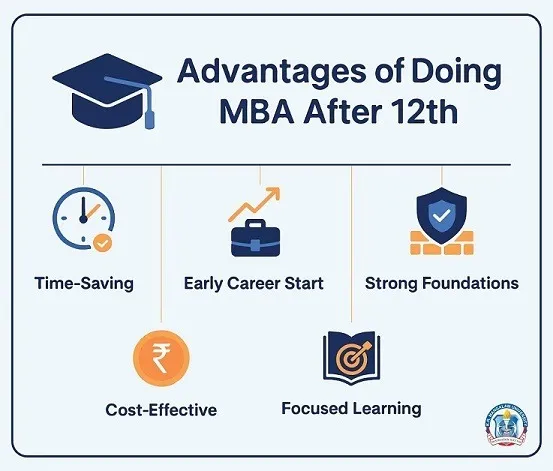
Advantages of Doing MBA After 12th

  1. Time-Saving – Earn both undergraduate and postgraduate degrees in 5 years.
  2. Early Career Start – Enter the corporate world earlier than peers who pursue a separate UG + MBA path.
  3. Strong Foundations – Gain continuous exposure to business studies from the beginning.
  4. Cost-Effective – Integrated programmes often cost less compared to pursuing UG and PG separately.
  5. Focused Learning – Students committed to a career in management avoid distractions of unrelated degree programmes.

Career Opportunities After Integrated MBA

Students completing an integrated MBA can explore diverse career options in top industries. Some popular career paths include:

  • Business Analyst – Bridges data insights with business strategies to improve decision-making. 

         Average Salary: ₹6–9 LPA

  • Marketing Manager – Plans and executes campaigns to promote products and build brand value. 

         Average Salary: ₹7–12 LPA

  • Financial Consultant – Provides expert advice on investments, taxation, and wealth management. 

         Average Salary: ₹5–10 LPA

  • Operations Manager – Oversees day-to-day business operations to ensure efficiency and growth. 

         Average Salary: ₹8–12 LPA

  • Human Resource Specialist – Manages recruitment, employee engagement, and workplace culture. 

         Average Salary: ₹4–7 LPA

  • Entrepreneur / Startup Founder – Builds and manages new ventures with innovative business ideas.

          Earnings vary widely; successful startups can scale to crores.

  • International Business Executive – Handles global trade, partnerships, and cross-border operations. 

         Average Salary: ₹9–15 LPA

Additionally, students from reputed institutes get placement opportunities with leading companies like Deloitte, Accenture, Google, Amazon, and major banks.

Please note: The salary figures mentioned above are approximate and have been taken from various internet sources. Actual packages may vary based on the industry, company, location, and individual skills.

Should You Choose an MBA After 12th?

If you are clear about pursuing a career in management, opting for an integrated MBA after 12th is a smart decision. However, if you are unsure, you may explore a bachelor’s degree first and later decide to pursue a regular MBA.

Factors to consider before enrolling:

  • Your interest in management subjects
  • Long-term career goals
  • Financial investment and ROI
  • Reputation of the chosen college

Conclusion

To sum up, the answer to “Can I do an MBA after 12th?” is ‘Yes’, through an integrated MBA programme. While a direct MBA after school isn’t possible, integrated courses provide students the opportunity to begin their management journey early.

Parents and students should carefully check MBA course eligibility and explore the best integrated MBA colleges in India before applying. If you’re wondering “How can I get admission in MBA after 12th?”. Well, the right preparation for entrance exams and good 12th-grade results are the first steps.

For ambitious students who dream of becoming future business leaders, after 12th MBA is possible and it may just be the perfect career launchpad.

FAQs

What labs and facilities are available in the integrated BBA + MBA programme at KRMU?

The programme is supported by modern, innovation-driven facilities that encourage practical learning and entrepreneurship. Students have access to the Entrepreneurship and Incubation Centre for startup support, a Design Thinking Lab to nurture creativity and innovation, a Business Simulation Lab for real-world scenario training, and well-equipped computer labs with industry-relevant software for hands-on experience in analytics, finance, and marketing.

Are there good internship and placement opportunities at KRMU?

Yes, K.R. Mangalam University has collaborated with various top industry giants like Microsoft, Paytm, Ziffyhomes, TCS, Deloitte, etc., offering students a platform to secure good internships and placements.

What does support from IBM mean?

It includes the following points: Industry-driven modules developed with IBM, integrating key concepts in Business Analytics, AI, Cloud Computing, and Digital Strategy. Regular interactions with IBM professionals and business leaders for enhanced industry exposure.

Does K.R. Mangalam University offer MBA after graduation?

Yes, KRMU offers MBA (HR/Marketing/ Finance/ IB/ Product Marketing/ Business Analytics/ IT/ Entrepreneurship/ Operations Management) with Academic Support from IBM.

can i do mba after 12th​

How Can I Do MBA After 12th? Admission & Eligibility

September 2, 2025

Many students, right after completing class 12, ask themselves, “Can I do MBA after 12th?” The answer to this common question is ‘Yes’, but not in the traditional way. While a regular MBA programme is a postgraduate degree (which requires a bachelor’s qualification), students can choose an integrated MBA course right after passing class 12.

This integrated programme combines undergraduate and postgraduate studies, allowing students to start early, save time, and build strong management foundations. For ambitious learners aiming for corporate leadership or entrepreneurial success, this path is ideal.

If you are asking questions like “How can I do MBA after 12th?” or “After 12th MBA is possible?” This detailed guide will clear all your doubts.

What is an Integrated MBA?

An integrated MBA is a 5-year dual degree programme that merges a bachelor’s degree (like a BBA, BMS, or equivalent) with a Master of Business Administration (MBA).

Highlights of an Integrated MBA

  • Duration: 5 years (10 semesters)
  • Degree Awarded: UG + PG (BBA/MBA or similar combination)
  • Entry Level: After Class 12
  • Specialisations: Finance, Marketing, HR, International Business, Data Analytics, and more

This programme allows you to start your management journey right after passing your class 12, unlike a regular MBA that requires you to first complete a bachelor’s degree.

Also Read: List of all MBA Specialization Courses

How Can I Do MBA After 12th?

If you want to pursue an MBA after 12th, the only route is through an integrated programme. K.R. Mangalam University (KRMU) offers an integrated BBA+MBA with academic support of IBM.

What is the BBA-MBA Integrated Programme?

The BBA-MBA integrated programme is a comprehensive, fast-tracked route for students who aspire to build strong careers in business and management. It blends the core principles of business administration with advanced leadership and strategic skills, ensuring students are well-prepared for the dynamic corporate world. 

Graduates of this programme can pursue diverse roles such as Marketing Manager, Human Resource Specialist, Financial Analyst, Operations Leader, or Business Consultant. By saving an extra year of study and offering continuous exposure to real-world business practices, this dual-degree course gives students a distinct advantage.

Here are a few important details about the integrated BBA+MBA course offered by KRMU:

Duration 5 Years
Programme Fee / Year Rs. 2,30,000 (as of September 2, 2025)
Eligibility Passed 10+2 or equivalent examination from any recognised board/university with minimum 50% aggregate marks.

Curriculum and Syllabus:

YEAR 1
SEMESTER I SEMESTER II
  • Principles of Management
  • Financial Accounting and Reporting
  • Fundamentals of Marketing
  • Indian Knowledge System
  • Micro Economics
  • Business Mathematics
  • Cyber Law and Governance
  • Commercial Laws
  • Individual and Organisational Behaviour
  • Cost and Management Accounting
  • Open Elective I
  • Health and Fitness
  • Business Statistics
  • Economic Environment and Policy
  • MS Excel for Business
  • Decision Science Tools in Business by IBM


YEAR 2
SEMESTER III SEMESTER IV
  • Managing Contemporary Human Resources
  • Operations Management
  • Advanced Excel
  • Project Management
  • GST and E Filing
  • Business Sustainability, Governance and Ethics
  • Sales and Distribution Management
  • Written Communication and English language
  • Summer Internship / Research Project
  • Research Methodology For Business
  • Supply Chain and Logistics Management
  • Introduction to Power BI, Python and SQL
  • Introduction to Digital Marketing
  • Introduction to Financial Management
  • Entrepreneurship Development
  • Open Elective II


YEAR 3
SEMESTER V SEMESTER VI
  • Operations Research
  • Block chains and crypto currency (Major taught internally)
  • Managing big data (Major taught internally)
  • Summer Internship / Research Project
  • General Awareness for Business
  • Oral Business Communication
  • AI Tools for Business
  • Strategic Management
  • Creating intelligent machines (Machine Learning) by IBM
  • Global Business Operations
  • Negotiation
  • Business Ethics, Values & Corporate Governance
  • Enterprise Resource Management (Major taught internally)
  • Challenges of Business Environment


YEAR 4
SEMESTER VII SEMESTER VIII
  • Organisational Structure, Culture and Design
  • Predictive Analytics by IBM
  • Specialization I Elective II
  • Specialization II Elective I
  • Specialization II Elective III
  • Marketing Research
  • Specialization I Elective I
  • Specialization I Elective III
  • Specialization II Elective II
  • Capstone Project
  • Specialization I Elective V
  • Specialization I Elective VII
  • Specialization II Elective V
  • Specialization II Elective VII
  • Specialization I Elective IV
  • Specialization I Elective VI
  • Specialization II Elective IV
  • Specialization II Elective VI


YEAR 5
SEMESTER IX SEMESTER X
  • Summer Internship Project Report
  • Project Based Learning
  • Dissertation-I
  • Social Immersion
  • Employability Certification
  • Dissertation-II


MBA Course Eligibility After 12th

Since a direct MBA after 12th is not possible, here’s the integrated MBA eligibility criteria:

  • Completion of 10+2 or equivalent from a recognised board.
  • Minimum aggregate marks: 50%–60% (varies across colleges and universities).
  • Entrance exam qualification (IPMAT, NPAT, SET, CUET, or college-specific tests like KREE).

Best Integrated MBA Colleges in India

If you are looking for the best integrated MBA colleges in India, here are some reputed names:

  • K.R. Mangalam University, Gurgaon – Offers an Integrated BBA+MBA with academic support of IBM.
  • IIM Indore – Offers the 5-year Integrated Programme in Management (IPM).
  • IIM Rohtak – Another prestigious IPM programme with excellent placements.
  • NMIMS (Mumbai & Other Campuses) – Integrated MBA via NPAT entrance.
  • Symbiosis International University (Pune) – Offers BBA+MBA through SET exam.
  • Christ University (Bangalore) – Known for integrated management programmes.

Also Read: Integrated BBA+MBA with academic support of IBM

Is MBA After 12th Possible Without Entrance Exams?

Many private universities and colleges allow direct admission into integrated MBA programmes based on class 12 marks. However, the most reputed institutions (like KRMU, IIMs and NMIMS) conduct entrance exams.

So, while after 12th MBA is possible without an entrance exam, the best career prospects usually come from reputed colleges where exams are mandatory.

Advantages of Doing MBA After 12th

Starting an MBA journey immediately after school has many benefits:

Advantages of Doing MBA After 12th

  1. Time-Saving – Earn both undergraduate and postgraduate degrees in 5 years.
  2. Early Career Start – Enter the corporate world earlier than peers who pursue a separate UG + MBA path.
  3. Strong Foundations – Gain continuous exposure to business studies from the beginning.
  4. Cost-Effective – Integrated programmes often cost less compared to pursuing UG and PG separately.
  5. Focused Learning – Students committed to a career in management avoid distractions of unrelated degree programmes.

Career Opportunities After Integrated MBA

Students completing an integrated MBA can explore diverse career options in top industries. Some popular career paths include:

  • Business Analyst – Bridges data insights with business strategies to improve decision-making. 

         Average Salary: ₹6–9 LPA

  • Marketing Manager – Plans and executes campaigns to promote products and build brand value. 

         Average Salary: ₹7–12 LPA

  • Financial Consultant – Provides expert advice on investments, taxation, and wealth management. 

         Average Salary: ₹5–10 LPA

  • Operations Manager – Oversees day-to-day business operations to ensure efficiency and growth. 

         Average Salary: ₹8–12 LPA

  • Human Resource Specialist – Manages recruitment, employee engagement, and workplace culture. 

         Average Salary: ₹4–7 LPA

  • Entrepreneur / Startup Founder – Builds and manages new ventures with innovative business ideas.

          Earnings vary widely; successful startups can scale to crores.

  • International Business Executive – Handles global trade, partnerships, and cross-border operations. 

         Average Salary: ₹9–15 LPA

Additionally, students from reputed institutes get placement opportunities with leading companies like Deloitte, Accenture, Google, Amazon, and major banks.

Please note: The salary figures mentioned above are approximate and have been taken from various internet sources. Actual packages may vary based on the industry, company, location, and individual skills.

Should You Choose an MBA After 12th?

If you are clear about pursuing a career in management, opting for an integrated MBA after 12th is a smart decision. However, if you are unsure, you may explore a bachelor’s degree first and later decide to pursue a regular MBA.

Factors to consider before enrolling:

  • Your interest in management subjects
  • Long-term career goals
  • Financial investment and ROI
  • Reputation of the chosen college

Conclusion

To sum up, the answer to “Can I do an MBA after 12th?” is ‘Yes’, through an integrated MBA programme. While a direct MBA after school isn’t possible, integrated courses provide students the opportunity to begin their management journey early.

Parents and students should carefully check MBA course eligibility and explore the best integrated MBA colleges in India before applying. If you’re wondering “How can I get admission in MBA after 12th?”. Well, the right preparation for entrance exams and good 12th-grade results are the first steps.

For ambitious students who dream of becoming future business leaders, after 12th MBA is possible and it may just be the perfect career launchpad.

FAQs

What labs and facilities are available in the integrated BBA + MBA programme at KRMU?

The programme is supported by modern, innovation-driven facilities that encourage practical learning and entrepreneurship. Students have access to the Entrepreneurship and Incubation Centre for startup support, a Design Thinking Lab to nurture creativity and innovation, a Business Simulation Lab for real-world scenario training, and well-equipped computer labs with industry-relevant software for hands-on experience in analytics, finance, and marketing.

Are there good internship and placement opportunities at KRMU?

Yes, K.R. Mangalam University has collaborated with various top industry giants like Microsoft, Paytm, Ziffyhomes, TCS, Deloitte, etc., offering students a platform to secure good internships and placements.

What does support from IBM mean?

It includes the following points: Industry-driven modules developed with IBM, integrating key concepts in Business Analytics, AI, Cloud Computing, and Digital Strategy. Regular interactions with IBM professionals and business leaders for enhanced industry exposure.

Does K.R. Mangalam University offer MBA after graduation?

Yes, KRMU offers MBA (HR/Marketing/ Finance/ IB/ Product Marketing/ Business Analytics/ IT/ Entrepreneurship/ Operations Management) with Academic Support from IBM.

Recent Post

Error: Contact form not found.

How Can I Do MBA After 12th? Admission & Eligibility

KRMU Team
KRMU Team
Published On: September 2, 2025
can i do mba after 12th​

Blog Content

Many students, right after completing class 12, ask themselves, “Can I do MBA after 12th?” The answer to this common question is ‘Yes’, but not in the traditional way. While a regular MBA programme is a postgraduate degree (which requires a bachelor’s qualification), students can choose an integrated MBA course right after passing class 12.

This integrated programme combines undergraduate and postgraduate studies, allowing students to start early, save time, and build strong management foundations. For ambitious learners aiming for corporate leadership or entrepreneurial success, this path is ideal.

If you are asking questions like “How can I do MBA after 12th?” or “After 12th MBA is possible?” This detailed guide will clear all your doubts.

What is an Integrated MBA?

An integrated MBA is a 5-year dual degree programme that merges a bachelor’s degree (like a BBA, BMS, or equivalent) with a Master of Business Administration (MBA).

Highlights of an Integrated MBA

  • Duration: 5 years (10 semesters)
  • Degree Awarded: UG + PG (BBA/MBA or similar combination)
  • Entry Level: After Class 12
  • Specialisations: Finance, Marketing, HR, International Business, Data Analytics, and more

This programme allows you to start your management journey right after passing your class 12, unlike a regular MBA that requires you to first complete a bachelor’s degree.

Also Read: List of all MBA Specialization Courses

How Can I Do MBA After 12th?

If you want to pursue an MBA after 12th, the only route is through an integrated programme. K.R. Mangalam University (KRMU) offers an integrated BBA+MBA with academic support of IBM.

What is the BBA-MBA Integrated Programme?

The BBA-MBA integrated programme is a comprehensive, fast-tracked route for students who aspire to build strong careers in business and management. It blends the core principles of business administration with advanced leadership and strategic skills, ensuring students are well-prepared for the dynamic corporate world. 

Graduates of this programme can pursue diverse roles such as Marketing Manager, Human Resource Specialist, Financial Analyst, Operations Leader, or Business Consultant. By saving an extra year of study and offering continuous exposure to real-world business practices, this dual-degree course gives students a distinct advantage.

Here are a few important details about the integrated BBA+MBA course offered by KRMU:

Duration 5 Years
Programme Fee / Year Rs. 2,30,000 (as of September 2, 2025)
Eligibility Passed 10+2 or equivalent examination from any recognised board/university with minimum 50% aggregate marks.

Curriculum and Syllabus:

YEAR 1
SEMESTER I SEMESTER II
  • Principles of Management
  • Financial Accounting and Reporting
  • Fundamentals of Marketing
  • Indian Knowledge System
  • Micro Economics
  • Business Mathematics
  • Cyber Law and Governance
  • Commercial Laws
  • Individual and Organisational Behaviour
  • Cost and Management Accounting
  • Open Elective I
  • Health and Fitness
  • Business Statistics
  • Economic Environment and Policy
  • MS Excel for Business
  • Decision Science Tools in Business by IBM


YEAR 2
SEMESTER III SEMESTER IV
  • Managing Contemporary Human Resources
  • Operations Management
  • Advanced Excel
  • Project Management
  • GST and E Filing
  • Business Sustainability, Governance and Ethics
  • Sales and Distribution Management
  • Written Communication and English language
  • Summer Internship / Research Project
  • Research Methodology For Business
  • Supply Chain and Logistics Management
  • Introduction to Power BI, Python and SQL
  • Introduction to Digital Marketing
  • Introduction to Financial Management
  • Entrepreneurship Development
  • Open Elective II


YEAR 3
SEMESTER V SEMESTER VI
  • Operations Research
  • Block chains and crypto currency (Major taught internally)
  • Managing big data (Major taught internally)
  • Summer Internship / Research Project
  • General Awareness for Business
  • Oral Business Communication
  • AI Tools for Business
  • Strategic Management
  • Creating intelligent machines (Machine Learning) by IBM
  • Global Business Operations
  • Negotiation
  • Business Ethics, Values & Corporate Governance
  • Enterprise Resource Management (Major taught internally)
  • Challenges of Business Environment


YEAR 4
SEMESTER VII SEMESTER VIII
  • Organisational Structure, Culture and Design
  • Predictive Analytics by IBM
  • Specialization I Elective II
  • Specialization II Elective I
  • Specialization II Elective III
  • Marketing Research
  • Specialization I Elective I
  • Specialization I Elective III
  • Specialization II Elective II
  • Capstone Project
  • Specialization I Elective V
  • Specialization I Elective VII
  • Specialization II Elective V
  • Specialization II Elective VII
  • Specialization I Elective IV
  • Specialization I Elective VI
  • Specialization II Elective IV
  • Specialization II Elective VI


YEAR 5
SEMESTER IX SEMESTER X
  • Summer Internship Project Report
  • Project Based Learning
  • Dissertation-I
  • Social Immersion
  • Employability Certification
  • Dissertation-II


MBA Course Eligibility After 12th

Since a direct MBA after 12th is not possible, here’s the integrated MBA eligibility criteria:

  • Completion of 10+2 or equivalent from a recognised board.
  • Minimum aggregate marks: 50%–60% (varies across colleges and universities).
  • Entrance exam qualification (IPMAT, NPAT, SET, CUET, or college-specific tests like KREE).

Best Integrated MBA Colleges in India

If you are looking for the best integrated MBA colleges in India, here are some reputed names:

  • K.R. Mangalam University, Gurgaon – Offers an Integrated BBA+MBA with academic support of IBM.
  • IIM Indore – Offers the 5-year Integrated Programme in Management (IPM).
  • IIM Rohtak – Another prestigious IPM programme with excellent placements.
  • NMIMS (Mumbai & Other Campuses) – Integrated MBA via NPAT entrance.
  • Symbiosis International University (Pune) – Offers BBA+MBA through SET exam.
  • Christ University (Bangalore) – Known for integrated management programmes.

Also Read: Integrated BBA+MBA with academic support of IBM

Is MBA After 12th Possible Without Entrance Exams?

Many private universities and colleges allow direct admission into integrated MBA programmes based on class 12 marks. However, the most reputed institutions (like KRMU, IIMs and NMIMS) conduct entrance exams.

So, while after 12th MBA is possible without an entrance exam, the best career prospects usually come from reputed colleges where exams are mandatory.

Advantages of Doing MBA After 12th

Starting an MBA journey immediately after school has many benefits:

Advantages of Doing MBA After 12th

  1. Time-Saving – Earn both undergraduate and postgraduate degrees in 5 years.
  2. Early Career Start – Enter the corporate world earlier than peers who pursue a separate UG + MBA path.
  3. Strong Foundations – Gain continuous exposure to business studies from the beginning.
  4. Cost-Effective – Integrated programmes often cost less compared to pursuing UG and PG separately.
  5. Focused Learning – Students committed to a career in management avoid distractions of unrelated degree programmes.

Career Opportunities After Integrated MBA

Students completing an integrated MBA can explore diverse career options in top industries. Some popular career paths include:

  • Business Analyst – Bridges data insights with business strategies to improve decision-making. 

         Average Salary: ₹6–9 LPA

  • Marketing Manager – Plans and executes campaigns to promote products and build brand value. 

         Average Salary: ₹7–12 LPA

  • Financial Consultant – Provides expert advice on investments, taxation, and wealth management. 

         Average Salary: ₹5–10 LPA

  • Operations Manager – Oversees day-to-day business operations to ensure efficiency and growth. 

         Average Salary: ₹8–12 LPA

  • Human Resource Specialist – Manages recruitment, employee engagement, and workplace culture. 

         Average Salary: ₹4–7 LPA

  • Entrepreneur / Startup Founder – Builds and manages new ventures with innovative business ideas.

          Earnings vary widely; successful startups can scale to crores.

  • International Business Executive – Handles global trade, partnerships, and cross-border operations. 

         Average Salary: ₹9–15 LPA

Additionally, students from reputed institutes get placement opportunities with leading companies like Deloitte, Accenture, Google, Amazon, and major banks.

Please note: The salary figures mentioned above are approximate and have been taken from various internet sources. Actual packages may vary based on the industry, company, location, and individual skills.

Should You Choose an MBA After 12th?

If you are clear about pursuing a career in management, opting for an integrated MBA after 12th is a smart decision. However, if you are unsure, you may explore a bachelor’s degree first and later decide to pursue a regular MBA.

Factors to consider before enrolling:

  • Your interest in management subjects
  • Long-term career goals
  • Financial investment and ROI
  • Reputation of the chosen college

Conclusion

To sum up, the answer to “Can I do an MBA after 12th?” is ‘Yes’, through an integrated MBA programme. While a direct MBA after school isn’t possible, integrated courses provide students the opportunity to begin their management journey early.

Parents and students should carefully check MBA course eligibility and explore the best integrated MBA colleges in India before applying. If you’re wondering “How can I get admission in MBA after 12th?”. Well, the right preparation for entrance exams and good 12th-grade results are the first steps.

For ambitious students who dream of becoming future business leaders, after 12th MBA is possible and it may just be the perfect career launchpad.

FAQs

What labs and facilities are available in the integrated BBA + MBA programme at KRMU?

The programme is supported by modern, innovation-driven facilities that encourage practical learning and entrepreneurship. Students have access to the Entrepreneurship and Incubation Centre for startup support, a Design Thinking Lab to nurture creativity and innovation, a Business Simulation Lab for real-world scenario training, and well-equipped computer labs with industry-relevant software for hands-on experience in analytics, finance, and marketing.

Are there good internship and placement opportunities at KRMU?

Yes, K.R. Mangalam University has collaborated with various top industry giants like Microsoft, Paytm, Ziffyhomes, TCS, Deloitte, etc., offering students a platform to secure good internships and placements.

What does support from IBM mean?

It includes the following points: Industry-driven modules developed with IBM, integrating key concepts in Business Analytics, AI, Cloud Computing, and Digital Strategy. Regular interactions with IBM professionals and business leaders for enhanced industry exposure.

Does K.R. Mangalam University offer MBA after graduation?

Yes, KRMU offers MBA (HR/Marketing/ Finance/ IB/ Product Marketing/ Business Analytics/ IT/ Entrepreneurship/ Operations Management) with Academic Support from IBM.