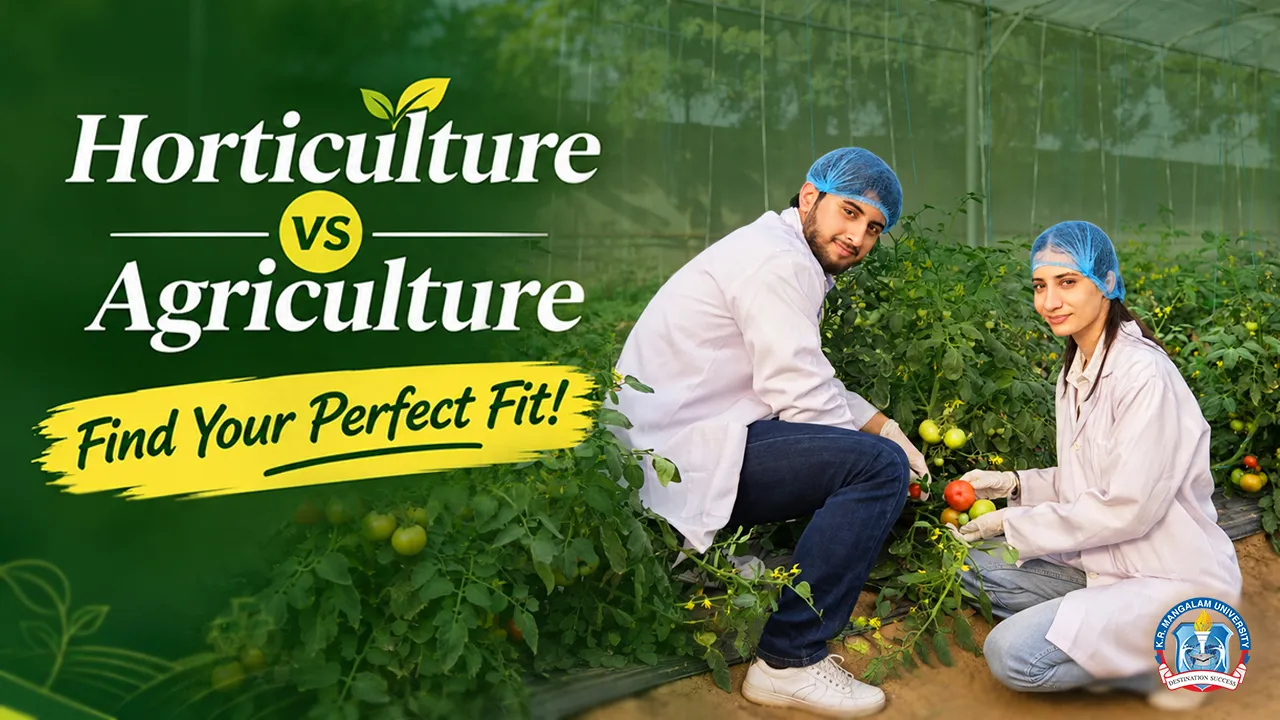
Students interested in farming, plant cultivation and sustainable food production often compare horticulture vs agriculture to understand which field better aligns with their academic interests and career goals. Although closely related, the two disciplines differ in their scope, cultivation practices, areas of specialisation and applications. Agriculture broadly focuses on crop production, soil management and farming systems, while horticulture specialises in cultivating fruits, vegetables, flowers, ornamental plants and other high-value crops
Studying agriculture or horticulture can help students develop the knowledge and practical skills needed to support sustainable farming, improve plant production and contribute to environmental conservation. Understanding the difference between agriculture and horticulture can help them make informed decisions about suitable courses and future career opportunities.
This blog post will help students to understand horticulture vs agriculture.
Difference Between Agriculture and Horticulture
After having a fair idea about agriculture and horticulture, let’s delve more into agriculture vs horticulture difference.
| Basis of Comparison |
Agriculture |
Horticulture |
| Meaning |
Agriculture is the broader practice of cultivating crops and raising livestock to produce food, fibre and other useful products. |
Horticulture is a branch of agriculture that focuses on cultivating fruits, vegetables, flowers, ornamental plants, trees and shrubs for food and decorative purposes. |
| Types of Crops and Plants |
Includes cereals, pulses, oilseeds, fibre crops and other field crops. |
Includes fruit crops, vegetables, flowers, nursery plants, herbs and ornamental plants. |
| Main Activities |
Crop cultivation, irrigation, soil management, harvesting, livestock care and farm management. |
Plant propagation, pruning, nursery management, pest control, harvesting and post-harvest handling. |
| Production Methods |
Often involves large-scale field cultivation and mechanised farming, depending on the crop and the farm. |
Often involves intensive cultivation and specialised plant-care techniques, including greenhouse and nursery production. |
| Technology and Practical Skills |
Uses farm machinery, irrigation systems, soil testing, crop monitoring and precision-farming tools. |
Uses propagation techniques, greenhouse systems, grafting, pruning, plant-health management and specialised cultivation methods. |
| Examples |
Growing wheat, rice, maize and cotton; dairy and poultry farming. |
Growing mangoes, grapes, tomatoes and flowers; managing nurseries and ornamental gardens. |
Also Read: B.Sc. Agriculture Admission Eligibility, Fees & Scope
What are the Key Differences Between Horticultural and Agricultural Societies?
Horticulture and agriculture have each shaped distinct types of societies, influencing how communities traditionally cultivated food, managed natural resources and organised their everyday lives. Understanding these differences helps students appreciate the role each practice has played in shaping human settlements and ways of life.
| Aspects |
Horticultural Societies |
Agricultural Societies |
|
|
|
| Meaning |
Societies that traditionally rely on small-scale plant cultivation using simple tools. |
Societies that rely on more intensive and organised farming practices to produce crops. |
| Cultivation Methods |
Use hand tools such as digging sticks and hoes to grow plants. |
Use ploughs, irrigation systems, machinery and other farming technologies. |
| Scale of Production |
Generally produce crops on smaller plots of land. |
Often cultivate larger areas of land for greater food production. |
| Main Activities |
Grow fruits, vegetables, roots, tubers and other useful plants. |
Grow cereals, pulses, oilseeds and commercial crops; livestock rearing may also be important. |
| Technology |
Traditionally, depend on relatively simple tools and techniques. |
May use advanced machinery, fertilisers, irrigation and modern crop-management systems. |
| Food Production |
Production is generally smaller in scale and may support local or community needs. |
Production can generate larger surpluses for storage, trade and distribution. |
| Settlement Patterns |
May be semi-nomadic or settle in communities, depending on cultivation practices. |
Often support more permanent settlements because fields require ongoing management. |
| Division of Labour |
Work is often organised within households or small communities. |
Larger-scale production may involve more specialised agricultural roles and labour arrangements. |
| Economic Activities |
Often combine plant cultivation with gathering, hunting or other local activities. |
Frequently support farming-based trade, food processing and other related economic activities. |
| Social Organisation |
Traditionally may have relatively small communities and less occupational specialisation. |
Agricultural surpluses can support larger populations, specialised occupations and more complex social structures. |
Note: Horticultural and agricultural societies are sociological categories that describe traditional ways of organising food production. They should not be confused with horticulture and agriculture as modern scientific disciplines.
Horticulture vs Agriculture in India
Both agriculture and horticulture play important roles in India’s food production, rural economy and sustainable development.
Scope of Horticulture in India
Horticulture offers opportunities in fruit and vegetable production, floriculture, nursery management, landscaping, plantation crops, medicinal plants and post-harvest management. Students interested in specialised plant cultivation may explore roles such as:
- Horticulture Officer
- Horticulturist
- Nursery Manager
- Floriculture Specialist
- Landscape Supervisor
- Fruit and Vegetable Production Consultant
- Horticultural Research Assistant
- Horticulture Business Entrepreneur
Potential employers include horticulture departments, research institutes, nurseries, landscaping companies, food-processing businesses, etc.
Scope of Agriculture in India
Agriculture offers opportunities across crop production, farm management, agricultural research, agribusiness and allied sectors. Graduates with relevant qualifications may explore roles such as:
- Agricultural Officer
- Agronomist
- Farm Manager
- Soil and Crop Consultant
- Agricultural Research Assistant
- Agri-business Executive
- Agricultural Extension Officer
Career opportunities may be available in government departments, research institutions, seed and fertiliser companies, food-processing businesses, etc.
B.Sc. Agriculture vs B.Sc. Horticulture
Students comparing these fields will be curious about B.Sc. Agriculture vs B.Sc. Horticulture.
B.Sc Agriculture vs B.Sc. Horticulture: Consider the subjects, practical training and career opportunities offered by each programme. While B.Sc. Agriculture covers a broad range of agricultural sciences, B.Sc. Horticulture focuses more specifically on fruit, vegetable, flower and ornamental plant cultivation.
| Comparison Factor |
B.Sc. Agriculture |
B.Sc. Horticulture |
| Course Focus |
Crop production, soil science, farm management and agricultural systems |
Fruit, vegetable, flower and ornamental plant cultivation |
| Core Subjects |
Agronomy, soil science, plant pathology, agricultural economics and entomology |
Fruit science, vegetable science, floriculture, plant propagation and nursery management |
| Practical Learning |
Field trials, crop management, soil testing and farm-based activities |
Orchard management, greenhouse cultivation, nursery practices and plant propagation |
| Career Options |
Agricultural officer, agronomist, farm manager and agricultural consultant |
Horticulturist, nursery manager, fruit and vegetable production specialist and floriculture professional |
| Higher Studies |
M.Sc. Agriculture and related specialisations |
M.Sc. Horticulture and related specialisations |
Students interested in crop production, farm management, and broader agricultural systems could benefit from a B.Sc. in Agriculture. For those interested in specialised plant cultivation, fruit and vegetable production, floriculture, or landscaping, a B.Sc. in horticulture may be more appropriate. Before selecting a programme, students should evaluate the curriculum, practical experience, and professional objectives.
Agriculture Education at K.R. Mangalam University
K.R. Mangalam University (KRMU) offers a four-year B.Sc. (Hons.) Agriculture programme for students interested in agricultural sciences, modern farming and sustainable food production. Key features of the programme include:
- Well-Structured Curriculum: Covers agronomy, soil science, horticulture, plant pathology, genetics and plant breeding, agricultural economics and farm management.
- Practical and Field-Based Learning: Field visits, laboratory sessions and farm projects help students apply classroom concepts to agricultural practices.
- Laboratory Facilities: Students can gain practical exposure through facilities such as agronomy, entomology, horticulture and plant research laboratories.
- Modern Agricultural Practices: The programme introduces students to sustainable farming, crop production, soil management and emerging agricultural technologies.
- Research and Project Work: Research activities, projects and practical assignments help students develop scientific thinking and problem-solving skills.
Also Read: Top B.Sc. Agriculture Colleges in Delhi NCR – Apply Now!
Conclusion
Understanding horticulture vs agriculture helps students evaluate the differences in their scope, practical applications, academic programmes and career opportunities. While agriculture encompasses a broad range of activities, including crop production, soil management and livestock farming, horticulture focuses on the specialised cultivation of fruits, vegetables, flowers and ornamental plants. Students should choose between B.Sc. Agriculture and B.Sc. Horticulture based on their academic interests and long-term career aspirations.
K.R. Mangalam University offers a B.Sc. (Hons.) Agriculture programme that combines agricultural sciences with practical learning and field-based activities. Students interested in building a career in the agricultural sector can explore the programme to understand its curriculum, hands-on training opportunities and admission requirements.
FAQs
Which is better, agriculture or horticulture?
Neither is universally better. Agriculture suits students interested in broader farming practices, while horticulture may appeal to those interested in fruits, vegetables, flowers, nurseries and landscaping.
What is the agriculture vs horticulture scope in India?
Both fields offer opportunities in government departments, research, agribusiness, farming, food processing and entrepreneurship. Horticulture also offers specialised opportunities in floriculture, nursery management and landscaping.
What are some horticulture vs agriculture examples?
Agriculture examples include wheat cultivation, rice farming and dairy farming. Horticulture examples include mango orchards, vegetable cultivation, flower production and ornamental gardening.
What is the difference between B.Sc. Agriculture and B.Sc. Horticulture?
B.Sc. Agriculture covers a wider range of agricultural sciences, including soil science, agronomy and farm management. B.Sc Horticulture focuses on specialised plant cultivation, including fruits, vegetables, flowers and ornamental plants.
Which course is better for government jobs: B.Sc. Agriculture or B.Sc. Horticulture?
Both can lead to government-sector opportunities, depending on the recruitment rules and qualifications required for each post. Agriculture graduates may explore agriculture-related roles, while horticulture graduates may pursue horticulture-specific positions.




 13 Schools700+ Faculty Members













 13+Years of Educational Experience