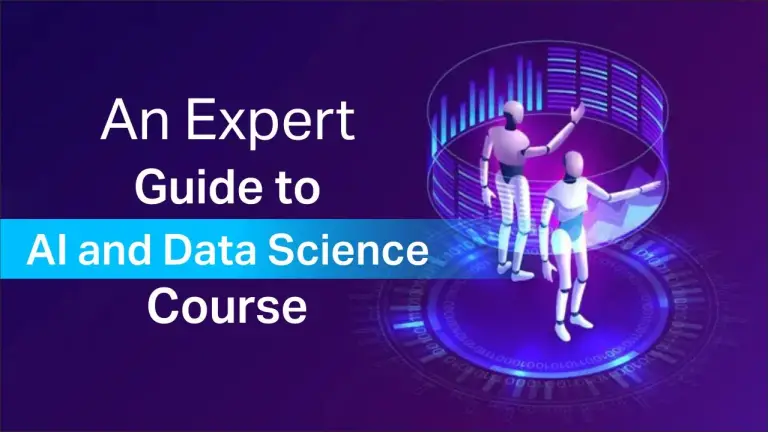
In recent years,Ai and Data Science Course has gained a lot of attention. AI is already part of our everyday lives and data science has emerged as a powerful tool to extract values from vast data. Many businesses strive to leverage the potential of AI and data science. As a result, the demand for professionals with expertise in these fields continues to rise.
If you’re looking to enhance your knowledge and skills in AI and data science, here we’ve provided you with an overview of what to expect from a comprehensive course.
AI and Data Science
AI (Artificial Intelligence) and Data Science are often mentioned together as they are closely related fields, but they have distinct focuses and objectives.
1. AI (Artificial Intelligence)
AI aims to create intelligent systems that can mimic human intelligence. It can perform tasks that required cognitive abilities. It focuses on developing algorithms and models that enable machines to learn, reason, and make decisions autonomously.
AI encompasses subfields like machine learning, deep learning, natural language processing, and computer vision. Applications of AI include autonomous vehicles, speech recognition, image processing, recommendation systems, and robotics.
2. Data Science
Data science focuses on extracting insights and knowledge from data through analysis and interpretation. It involves utilizing statistical and mathematical techniques, programming skills, and domain knowledge to uncover patterns and trends in data.
Data science encompasses areas such as data cleaning, exploratory data analysis, predictive modelling, and data visualization. Its applications span across various domains, including finance, healthcare, marketing, and social sciences.
While AI and data science overlap in certain areas, their primary objectives and methodologies differ. AI focuses on creating intelligent systems that can perform tasks autonomously, while data science focuses on extracting insights.
Data science provides the tools and techniques to analyze and interpret data, whereas AI utilizes these techniques to create intelligent systems. Both fields play crucial roles in the advancement of technology and have significant impacts on various industries.
Understanding AI and Data Science
AI and Data Science courses are way more different than they look. They are fields that involve the analysis and interpretation of data to derive insights and make informed decisions. AI focuses on developing intelligent machines that can perform various tasks.
Some of the key tasks, such as speech recognition, decision-making, and problem-solving.
It encompasses subfields like machine learning and deep learning. Data Science, on the other hand, deals with the collection and processing. Along with analyzing large volumes of data, to extract meaningful patterns and insights.
It involves techniques from statistics, mathematics, and programming to uncover valuable information. Both fields are interconnected and often work together to create innovative solutions and technologies.
Choosing the Right Course
- Researching and comparing AI and data science courses.
- Understanding the curriculum and learning objectives.
- Considering the course format (online, in-person, blended) and flexibility.
- Assessing the reputation and credentials of the institution or provider offering the course.
Key Components of an AI and Data Science Course
- Fundamentals of programming and software development.
- Introduction to statistical analysis and mathematics for data science.
- Machine learning algorithms: Supervised learning, unsupervised learning, reinforcement learning, and deep learning.
- Data acquisition, preprocessing, and data cleaning techniques.
- Exploratory data analysis and data visualization.
- Model evaluation, validation, and performance metrics.
- Introduction to natural language processing (NLP) and computer vision.
- Ethical considerations and bias in AI and data science.
Hands-on Learning and Projects
- Practical exercises and coding assignments to apply concepts learned.
- Real-world datasets and case studies to solve data problems.
- Developing and implementing AI models and algorithms.
- Collaborative projects and team-based learning experiences.
- Integration of tools and frameworks such as Python, R, TensorFlow, and PyTorch.
Industry Connections and Networking
- Guest lectures and talks by industry experts and practitioners.
- Industry partnerships and internship opportunities.
- Networking events and forums to connect with professionals in the field.
- Career guidance and advice from experienced mentors.
Capstone Project and Portfolio Building
- Undertaking a capstone project to apply acquired skills and knowledge.
- Designing and implementing an end-to-end AI or data science solution.
- Showcasing the project in a portfolio to demonstrate proficiency to potential employers.
- Seeking feedback and guidance from instructors and mentors.
Career Opportunities and Further Education
- Exploring diverse career paths in AI and data science.
- Job market trends and in-demand skills.
- Resume and interview preparation guidance.
- Continuing education options, such as specialized courses or advanced degrees.
Conclusion
Embarking on a data science and ai course offers an excellent opportunity to gain in-depth knowledge and skills in these rapidly growing fields. By understanding the fundamentals, engaging in hands-on learning, and leveraging industry connections, you can position yourself for exciting career opportunities.
Keep in mind the importance of choosing the right course for your career. Building a strong portfolio, and staying updated with the latest advancements in AI and data science, can maximize your learning experience and professional growth.
Also Read: Data Analyst vs Data Scientist : Which Career to Opt for?
FAQs
Here are some frequently asked questions about AI and Data Science courses.
What is the difference between Artificial Intelligence and Data Science?
Artificial Intelligence focuses on developing systems that simulate human intelligence, while Data Science involves collecting, analysing, and interpreting data to generate insights and support decision-making.
What skills are important for AI and Data Science students?
Students should develop skills in programming, mathematics, statistics, machine learning, data visualisation, problem-solving, and analytical thinking.
What career opportunities are available after AI and Data Science courses?
Graduates can pursue careers as Data Scientists, AI Engineers, Machine Learning Engineers, Business Analysts, Data Analysts, Robotics Engineers, and AI Researchers.
Which industries hire AI and Data Science professionals?
Industries such as healthcare, finance, e-commerce, cybersecurity, IT, banking, manufacturing, and digital marketing actively hire AI and Data Science professionals.




 13 Schools700+ Faculty Members














 13+Years of Educational Experience