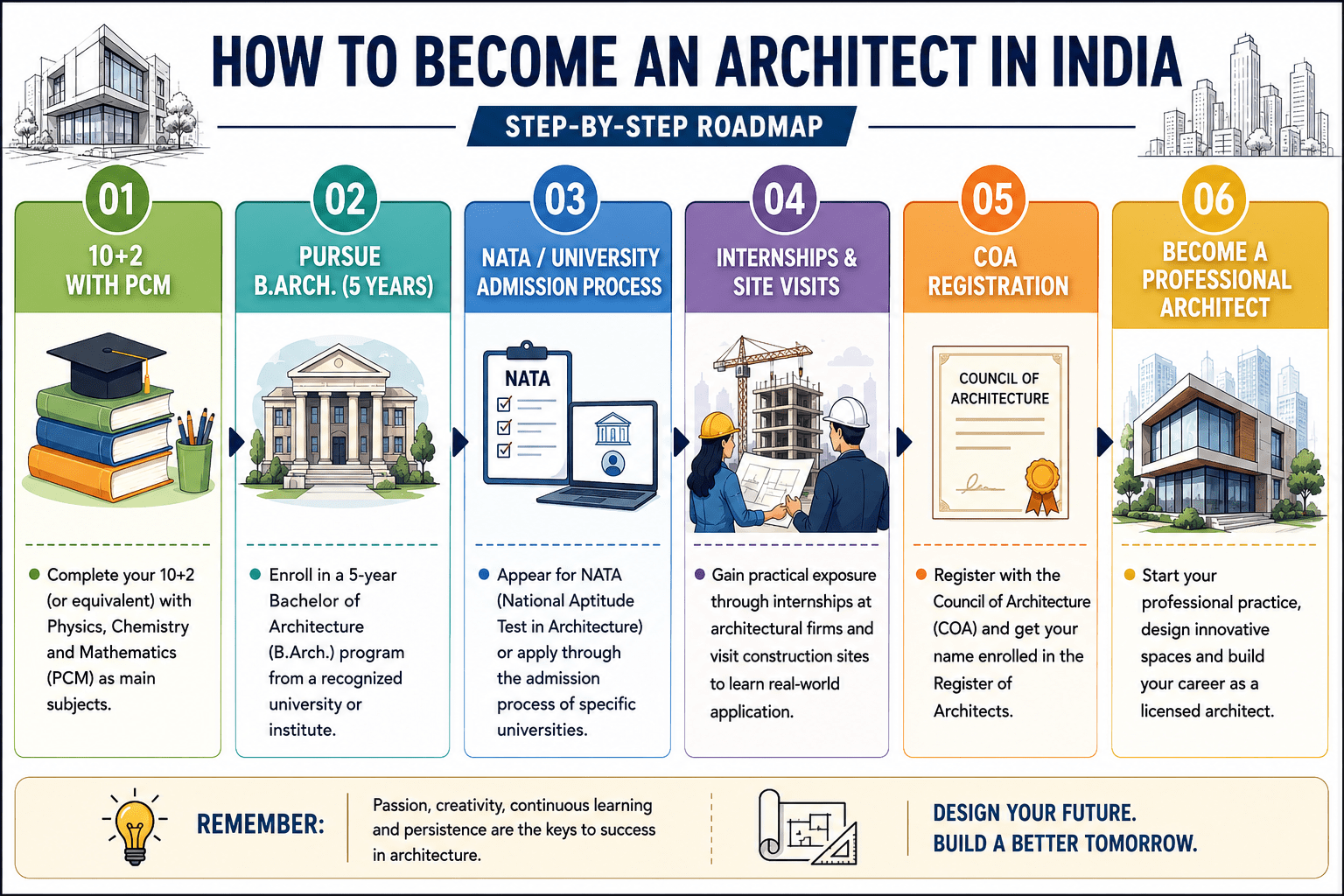
Architecture remains one of the few professions that blends design, engineering, sustainability, technology, and urban development into a single career path. As India’s cities continue to expand and infrastructure projects grow, the demand for qualified architects continues to evolve. If you have a passion for design, a keen eye for detail, and aesthetically pleasing spaces, an architecture programme could be a great fit for you. The B.Arch. programme is a 5-year undergraduate degree designed to develop creative, analytical, and technically skilled architects.
In this blog, aspirants get to learn how to become an architect in India.
Overview of This Blog
| Sections |
Descriptions |
| Who Is an Architect? Role and Day-to-Day Responsibilities |
Explains who architects are, their role in designing and planning spaces, and their key daily responsibilities such as design, drawings, site visits, client communication, and project coordination. |
| Why Is Architecture Becoming Increasingly Important? |
Explains how architecture is connected to India’s growth in infrastructure, urban development, real estate, sustainability, and smart city projects, creating long-term demand for skilled architects. |
| How to Become an Architect in India? |
Provides a step-by-step roadmap covering 10+2 requirements, B.Arch admission, NATA, architectural education, practical exposure, COA registration, and optional postgraduate studies. |
| B.Arch. Eligibility Criteria at a Glance |
Information on this programme in a tabular form. |
| How Many Years It Takes: Full Timeline |
Explains the typical 5-year B.Arch. pathway, including the course duration, practical training, and opportunities for higher studies. |
| Why Consider K.R. Mangalam University for Architecture? |
Highlights the university’s B.Arch programme, eligibility criteria, fee structure, industry-orientated curriculum, studio-based learning, infrastructure, and career support. |
| Top Career Opportunities After Architecture Courses |
Explores emerging career paths such as Sustainable Architect, Urban Planner, BIM Specialist, Smart City Consultant, Green Building Consultant, and more. |
| Conclusion |
Summarises the career path in architecture and describes how K.R. Mangalam University may assist students in laying a solid basis for success in the workplace. |
Who Is an Architect? Role and Day-to-Day Responsibilities
An architect is a professional who plans, designs, and oversees the development of buildings and other physical spaces. Their work combines design, technical knowledge, creativity, and problem-solving to create spaces that are functional, safe, sustainable, and visually appealing.
Role of an Architect
- Design Planning: Develop concepts and designs based on the client’s requirements and project objectives.
- Technical Drawings: Prepare detailed architectural drawings, plans, and 3D models.
- Project Coordination: Work with engineers, contractors, interior designers, and other professionals.
- Site Visits: Inspect construction sites to monitor progress and ensure designs are followed.
- Client Communication: Discuss ideas, budgets, design changes, and project requirements with clients.
- Regulatory Compliance: Ensure projects follow relevant building codes, regulations, and safety standards.
Day-to-Day Responsibilities
An architect’s daily work may include designing layouts, reviewing drawings, attending client meetings, coordinating with project teams, visiting construction sites, preparing documentation, and making design modifications based on project requirements.
Write it after the “B.Arch. Eligibility Criteria at a Glance” section
How Many Years It Takes: Full Timeline
Becoming an architect generally takes 5 years after Class 12, including a 5-year B.Arch. programme. Students can then pursue internships, practical training, and professional registration as required. Those who choose higher studies, such as an M.Arch., may spend additional years developing advanced expertise.
Why Is Architecture Becoming Increasingly Important?
Aspirants should understand why architecture is becoming increasingly important before they learn how to become an architect.
Architecture is closely linked to some of India’s fastest-growing sectors, including infrastructure, urban development, real estate, sustainability, and smart city projects.
- India’s construction sector contributes nearly 9% of the country’s GDP and employs more than 70 million people, making it one of the largest employment-generating industries in the country.
- The value of construction activity contributing to India’s economy exceeded ₹15 trillion in 2024, reflecting continued investment in infrastructure and urban development.
- The government-backed National Infrastructure Pipeline (NIP) involves investments worth approximately US$1.5 trillion, creating long-term demand for architects, planners, designers, and construction professionals.
- India’s construction market is projected to grow substantially over the coming years, driven by smart cities, urban housing, transportation networks, commercial developments, and sustainable infrastructure projects.
Skills Every Architect Should Develop
Architects today need more than just design skills. Employers want people who can solve real problems too — using technology, sustainable practices, and good communication.
What skills matter most? Quite a few, actually:
- Creative thinking and visualisation
- Technical drawing and CAD software
- Building Information Modelling (BIM)
- Problem-solving and analytical skills
- Knowledge of construction materials
- Communication and teamwork
- Sustainable design principles
Build these during your B.Arch. programme, and internship chances go up. Long-term career growth follows, too.
Architect Salary in India (2026): Entry to Senior Level
An architect’s salary in India varies based on experience, skills, specialisation, location, employer, and project responsibilities. Entry-level professionals generally earn less, while salaries tend to increase with experience and expertise.
| Experience Level |
Approx. Salary Range in India (2026) |
| Entry-Level Architect (0–2 years) |
₹3–5 LPA |
| Mid-Level Architect (3–7 years) |
₹5–10 LPA |
| Senior Architect (8+ years) |
₹10–20+ LPA |
| Principal/Lead Architect |
₹15–30+ LPA |
Note: The salary figures provided are approximate and can vary significantly across organisations and locations. Experienced architects and those in senior or leadership positions may earn considerably higher packages.

How to Become an Architect in India?
To become an architect in India, you will need to follow a specific educational and professional path. Here are the steps to become an architect after 12th grade:
Step 1. Choose the Science Stream in 10+2: In high school (10+2), select the science stream with physics, chemistry, mathematics, etc. as core subjects. An architecture course requires a strong foundation in these subjects.
Step 2. Pursue a Bachelor’s Degree in Architecture: After completing your 12th grade, you need to enrol in a bachelor’s degree programme in architecture (B.Arch.). An architect course is typically five years long. It’s offered by various government universities and top private universities is often based on entrance exams conducted by respective institutions or state-level examinations, such as the National Aptitude Test in Architecture (NATA).
NATA is one of the most recognised architecture entrance examinations in India. The examination evaluates:
- Drawing ability
- Visual perception
- Aesthetic sensitivity
- Logical reasoning
- Creative thinking
- Architectural awareness
Some universities have their own admission process for B.Arch. programmes; however, they may still offer scholarships or other benefits to students based on their NATA scores.
Step 3. Complete the Architecture Degree: While studying architecture, you will study various aspects of architecture, including design principles, construction techniques and computer-aided design (CAD) to get an architecture degree. You will also participate in studio projects and internships to gain practical experience.
Step 4. Gain Practical Exposure
Throughout the B.Arch. programme, students participate in architectural training, studio work, site visits, internships, and practical projects. These experiences help them understand real-world design, construction processes, and professional practice.
Step 5. Register with the Council of Architecture (COA): Once you have completed your practical training, you need to register with the Council of Architecture (COA). It’s a regulatory body for the architectural profession in India. You will need to submit the necessary documents and fulfil the registration requirements set by the COA. You will need to qualify for the architecture examination conducted by the COA. This exam assesses your knowledge and competency in architectural design, building regulations, and professional practice.
Postgraduate Studies (Optional Step): Although not mandatory, you may choose to pursue a postgraduate degree in architecture, such as a Master’s in Architecture (M.Arch.), to specialise in a specific area of interest or to gain advanced knowledge in the field.
B.Arch. Eligibility Criteria at a Glance
| Particular |
Details |
| Course |
Bachelor of Architecture (B.Arch.) |
| Duration |
5 Years |
| Qualification |
10+2 or 10+3 Diploma |
| Mandatory Subjects |
Physics & Mathematics |
| Minimum Marks |
45% Aggregate |
| Entrance Exam |
NATA (Preferred by most universities) |
| Course Type |
Undergraduate |
Why Consider K.R. Mangalam University for Architecture?
Choosing the right architecture university can significantly influence your learning experience and career growth.
K.R. Mangalam University offers a Bachelor of Architecture programme. Here are the basic details of this programmes.
Duration: 5 Years
Annual Fee: ₹2,10,000 per year (latest admission page)
Eligibility:
- Passed 10+2 or equivalent examination.
- Physics and mathematics as compulsory subjects.
- One of the following subjects: chemistry, biology, computer science, information technology, engineering graphics, business studies, or a technical vocational subject.
- Minimum 45% aggregate marks.
- Candidates with a 10+3 diploma with mathematics and at least 45% marks are also eligible.
KRMU’s B.Arch. programme is well known because of:
NATA-Based Scholarships at K.R. Mangalam University
Students applying for the B.Arch. programme can also benefit from merit-based scholarships through their NATA scores. The university offers financial support to encourage talented and aspiring architects to pursue their education with greater ease
| NATA Score |
Scholarship |
|
130.01 & above
|
100% Scholarship |
| 110.01 – 130 |
35% Scholarship
|
| 90 – 110 |
25% Scholarship
|
Note: Students should refer to the latest admission brochure or contact the university admissions team for updated scholarship information.
Industry-Oriented Curriculum
Students learn architectural design, planning, construction, sustainability, and emerging technologies through a contemporary curriculum.
Studio-Based Learning
The programme emphasises design studios, model making, project-based learning, and practical application.
Modern Infrastructure
Students have access to design studios, digital learning resources, workshops, and technology-enabled learning environments.
Industry Exposure
Workshops, site visits, internships, and expert interactions help students understand real-world architectural practice.
Career Development Support
Students receive guidance through internships, portfolio development, skill-building initiatives, and career support activities.
Top Career Opportunities After Architecture Courses
India is one of the fastest-developing countries that require qualified professionals for roles such as:
| Career Options |
Descriptions |
Average Salary |
| Sustainable Architects |
Sustainable architects design environmentally responsible buildings that minimise energy consumption, reduce waste, and promote sustainable construction practices. |
₹4 LPA – ₹10 LPA |
| Urban Planners |
Urban planners develop plans for cities, towns, and communities by focusing on land use, transportation systems, housing, and sustainable urban development. |
₹5 LPA – ₹12 LPA |
| Landscape Architects |
Landscape architects design outdoor spaces such as parks, gardens, campuses, waterfronts, and public spaces while balancing aesthetics and environmental considerations. |
₹4 LPA – ₹9 LPA |
| BIM Specialists |
Building Information Modelling (BIM) specialists use digital technologies to create intelligent 3D models that support planning, design, construction, and facility management. |
₹5 LPA – ₹12 LPA |
| Interior Designers / Interior Architects |
These professionals create functional, aesthetically appealing, and user-friendly interior spaces for residential, commercial, hospitality, and corporate projects. |
₹4 LPA – ₹10 LPA |
| Smart City Consultants |
Smart city consultants work on technology-enabled urban infrastructure projects involving mobility, sustainability, digital governance, and urban innovation. |
₹6 LPA – ₹15 LPA |
| Green Building Consultants |
Green building consultants advise developers and organisations on sustainable design practices, energy efficiency, environmental compliance, and green building certifications. |
₹5 LPA – ₹12 LPA |
| Architectural Visualisers |
Architectural visualisers create realistic 3D renderings, walkthroughs, animations, and digital presentations that help clients visualise their projects before construction. |
₹4 LPA – ₹9 LPA |
| Computational Designers |
Computational designers use advanced software, coding, and parametric design tools to develop innovative architectural forms and optimise building performance. |
₹6 LPA – ₹15 LPA |
| Set Designer |
Set designers create visual environments for films, television, theatre productions, exhibitions, events, and commercial shoots. |
₹4 LPA – ₹10 LPA |
| Real Estate Design Consultants |
Real estate design consultants work with developers and property firms to optimise project design, functionality, aesthetics, marketability, and user experience. |
₹5 LPA – ₹12 LPA |
Top Recruiters Hiring Architecture Graduates
Architecture graduates find opportunities across private firms, government organisations, infrastructure companies, and international design consultancies. Some leading recruiters include:
Many graduates also establish independent architecture and interior design practices after gaining professional experience.
Conclusion
Architecture is much more than designing buildings—it is about shaping the spaces, cities, and communities where people live, work, and interact. With India’s rapid urbanisation, infrastructure expansion, smart city initiatives, and a growing focus on sustainable development, the demand for skilled architects continues to evolve across diverse sectors.
The journey to becoming an architect requires creativity, technical knowledge, practical exposure, and continuous learning. From pursuing a B.Arch. degree and gaining hands-on experience to exploring specialised careers in urban planning, sustainable design, BIM, and smart city development, architecture offers a wide range of rewarding opportunities.
For aspiring architects looking to build a strong foundation, K.R. Mangalam University provides industry-orientated learning, studio-based education, practical exposure, and career development support to help students prepare for the future of the profession.
Ready to turn your creativity into a career?
Explore the B.Arch. programme at K.R. Mangalam University and take the first step towards becoming a future-ready architect.
FAQs
What is an architecture course?
An architecture course focuses on designing buildings and spaces while combining creativity, technical knowledge, and practical skills.
What stream should I choose after 10th to become an architect?
You must choose the Science stream with Physics, Chemistry, and Mathematics (PCM) in 10+2.
Which entrance exams are required for architecture in India?
Common entrance exams include NATA and JEE Main Paper 2.
How long does it take to become an architect?
A Bachelor of Architecture (B.Arch) typically takes 5 years to complete.
Is registration mandatory to practice as an architect in India?
Yes, you must register with the Council of Architecture to practice legally.




 13 Schools700+ Faculty Members













 13+Years of Educational Experience