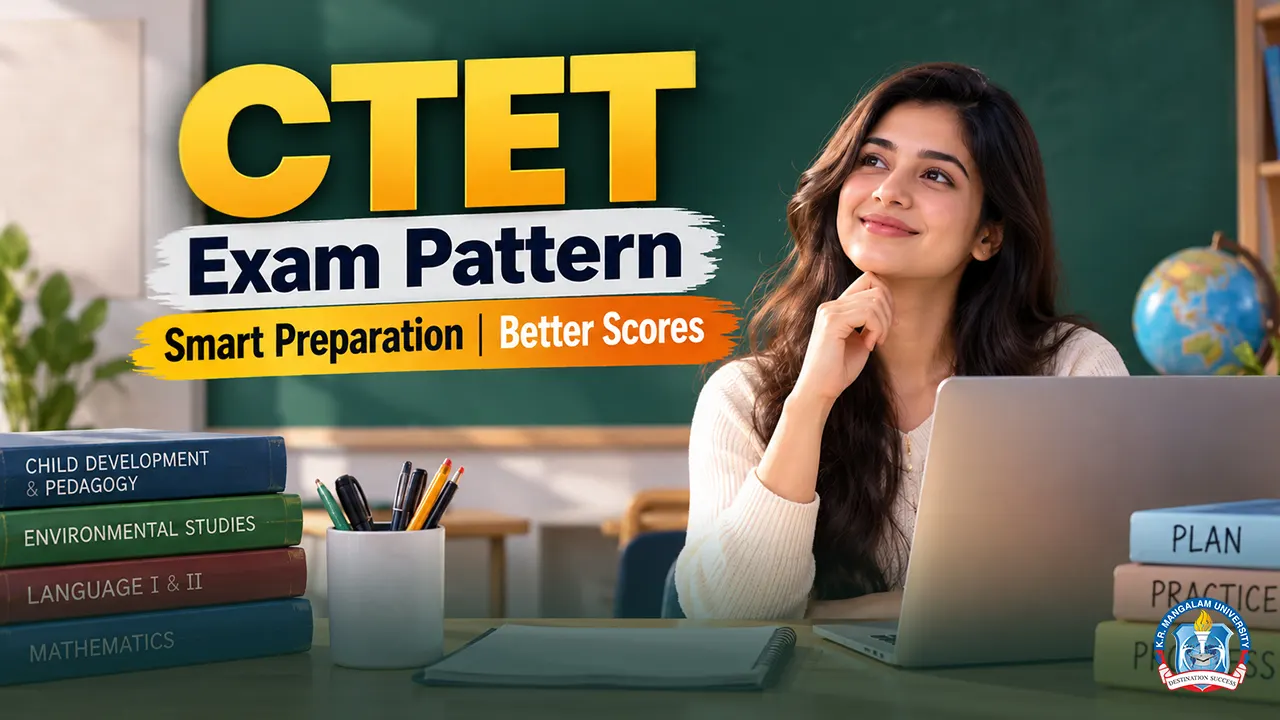
Right of Children to Free and Compulsory Education (RTE) Act, 2009, with the National Council for Teacher Education (NCTE), established minimum qualifications for an individual to qualify as a teacher for Classes 1st to 8th.
One of these qualifications made the Central Teacher Eligibility Test (CTET) mandatory for teachers. CTET exam is conducted by the Central Board of Secondary Education (CBSE), and with its 22nd edition, the board announced the reopening of the application window from 25 August to 1 September 2026. Also, the Central Board of Secondary Education (CBSE) has released the examination date for the Central Teacher Eligibility Test (CTET) September 2026 examination on its official website. The CTET exam will be conducted on 12 and 13 December 2026.
In today’s write-up, we discuss the meaning and importance of CTET along with important questions such as CTET exam pattern, 2026 syllabus, eligibility criteria, examination date, key highlights and more. Keep reading this blog to learn everything about the CTET exam.
Quick Glance At the Blog
We have created an overview of this write-up, mentioning details such as the meaning and key highlights of the CTET exam, the 2026 exam pattern and syllabus. We have also discussed the eligibility criteria and answered the frequently asked questions. Check the overview in the tabular format below.
| Section |
What We Will Cover |
| What is the CTET Exam? |
We will discuss the meaning and benefits of qualifying for the CTET exam. |
| Key Highlights of CTET Exam |
Here, we have listed some important facts related to the exam. |
| CTET Exam Pattern 2026: CTET Exam Structure and Marking Scheme |
Check out the CTET exam pattern with structure and marking scheme. |
| CTET Syllabus 2026 |
We have listed the complete syllabus with key topics important for the exam. |
| What are the Eligibility Criteria for the CTET Exam? |
We have listed all possible eligibility criteria acceptable for appearing in CTET Paper 1 & 2 exams. |
| Why Aspiring Teachers Should Choose KRMU? |
NEP-Aligned Curriculum, Teaching Opportunities via Internships, Expert & Experienced Faculty, Dedicated Placement Assistance. |
| Frequently Asked Questions |
We have listed questions that are frequently asked about CTET exams. |
CTET Exam Date Announced!
The Central Board of Secondary Education (CBSE) has officially announced the CTET 2026 examination dates on its website. As per the latest schedule, the exam will be held on December 12 and 13, 2026, instead of the earlier scheduled date of September 6. Candidates will be able to access and download the CTET 2026 admit card through the official login window using their credentials. The application window had previously been reopened from August 25 to September 1, 2026, at the official CTET website, ctet.nic.in.
What is the CTET Exam?
Before discussing the CTET exam pattern, let’s understand its meaning. CTET, or Central Teacher Eligibility Test, is a national-level exam conducted by CBSE to evaluate if a candidate qualifies to become a teacher for primary (Class 1-5) and upper primary classes (Class 6-8) across Indian schools. CTET is basically a benchmark to ensure that all schools (private and government) provide high-quality teaching to children in the country.
CTET exam is held twice every year and is applicable for teaching positions in CBSE and non-CBSE schools. This exam consists of two papers, Paper 1 and Paper 2. CTET Paper 1 is for Classes 1-5, while Paper 2 is for Classes 6-8. We have listed some benefits of taking the CTET examination 2026.
- One key benefit of taking the CTET exam is that it is a mandatory qualifier for securing a government teaching position.
- The CTET scores are applicable across all states in the country. Candidates can even apply in state-run schools.
- If a candidate qualifies in the CTET exam, they will get a certificate valid for life. They need not retake the exam to activate the qualification.
- Most reputed and recognised private schools prioritise CTET scorers over other teachers.
- There is no upper age limit in CTET, and the candidates can appear at any stage and age.
Also Read: What to do after CTET qualification Detailed Guide
What is the duration of the CTET exam?
The CTET exam duration is 2 hours 30 minutes for each paper. |
Key Highlights of CTET Exam
Check out the key highlights of the CTET examination 2026.
| Highlights |
Details |
| Full Name |
Central Teacher Eligibility Test (CTET) |
| Conducting Body |
Central Board of Secondary Education (CBSE) |
| Exam Level |
National |
| Exam Frequency |
Twice a year |
| Mode of Examination |
Offline |
| Mode of Application |
Online |
| Last Date of Application |
1st September 2026 |
| Date of Examination |
12-13 December 2026 |
| Date of Results |
Yet to be Announced |
| Total Papers |
2 |
| Total Questions |
150 Questions per paper |
| Type of Questions |
MCQs (Multiple Choice Questions) |
| Duration of CTET |
2 hours 30 minutes per paper |
| Total Marks |
150 marks per paper |
| Qualifying Marks |
90 marks (60%) |
| Negative Marking |
None |
| Medium of Examination |
Hindi and English (excluding Language sections) |
| Official Website |
https://ctet.nic.in/ |
Is there negative marking in CTET?
No, there is no negative marking in CTET. |
We have discussed the 2026 CTET exam pattern in detail in the section below.
CTET Exam Pattern 2026: CTET Exam Structure and Marking Scheme
In this section, we will discuss the latest pattern and look if there have been any new CTET exam pattern changes. We will discuss both the CTET Paper 1 and Paper 2 pattern.
| Particulars |
CTET Paper 1 |
CTET Paper 2 |
| Mode of Examination |
Offline |
Offline |
| Total Subjects or Sections |
5 |
4 |
| Names of Subjects/Sections |
- Child Development and Pedagogy
- Language-I
- Language-II
- Mathematics
- Environmental Studies
|
- Child Development and Pedagogy
- Language-I
- Language-II
- Mathematics and Science or Social Studies/Social Science
|
| Exam Duration |
2 hours 30 minutes |
2 hours 30 minutes |
| Total Questions |
150 |
150 |
| Total Marks |
150 |
150 |
| Marking Scheme |
for correct answer
0 for incorrect answer |
for correct answer
0 for incorrect answer |
It is important to note that each subject/section of CTET Paper 1 carries 30 marks, making 150 total marks. On the other hand, for CTET Paper 2, subjects/sections Child Development and Pedagogy, Language-I and Language-II carry 30 marks while Mathematics and Science or Social Studies/Social Science carry 60 marks, making 150 total marks.
Is it compulsory to give both Paper 1 and Paper 2 in CTET?
No. It is not mandatory for candidates to give both CTET Paper 1 and 2. They can choose either or both, depending on their career goals. |
CTET Syllabus 2026
After the CTET exam pattern, let’s quickly understand the CTET syllabus 2026 and the key topics.
style=”text-align: center !important;”
| CTET Paper 1 Syllabus |
Key Topics |
CTET Paper 2 Syllabus |
Key Topics |
| Child Development and Pedagogy |
Educational Psychology, Socialisation, Learning and Pedagogy & Inclusive Education |
Child Development and PLanguage-Iedagogy |
Child Development (Elementary School Child), Inclusive Education & Learning and Pedagogy |
| Language-I |
Comprehension, Pedagogy of its Development |
Language-I |
Comprehension, Pedagogy of its Development |
| Language-II |
Comprehension, Pedagogy of its Development |
Language-II |
Comprehension, Pedagogy of its Development |
| Mathematics |
Geometry, Data Handling, Patterns, Pedagogical Issues like Nature of Maths, Evaluation Method, Teaching Method, Maths in Curriculum |
Mathematics and Science
OR |
Number system, Algebra, Geometry, Data Handling, Nature of Maths, Its Curriculum, Evaluation, Remedial Teaching.
Food Sources & Components, Natural Phenomena
|
| Environmental Studies |
Family & Relationship, Concept and Scope of EVS, Learning Principles, Teaching Approach |
Social Studies/Social Science |
History, Geography, Social and Political Life, Pedagogical Issues |
What are the Eligibility Criteria for the CTET Exam?
Now that you are well-versed with the CTET exam pattern, let’s break down the eligibility criteria for this exam. The eligibility criteria to attempt CTET differ for both Paper 1 and Paper 2. Let’s take a look at both.
Eligibility for CTET Paper 1
To teach Classes 1-5, a candidate must fulfil the following criteria:
- The educational criteria must include a qualification for Senior Secondary (or equivalent) with at least 50% marks. The candidates also must have passed/appeared in a 2-year Diploma in Elementary Education (D.El.Ed).
OR
- The candidate must have secured 45% marks in Senior Secondary and have passed/appeared in a 2-year D.El.Ed as per NCTE regulations.
Alternatively, a candidate with a Bachelor of Education (B.Ed.) degree is also acceptable. However, this can vary from one school to another.
Eligibility for CTET Paper 2
A candidate must fulfil the criteria below for CTET Paper 2 to teach Classes 5-8.
- Graduation with at least 50% marks and passed/appearing in a 2-year Bachelor in Education (B.Ed).
OR
- Graduation with 45% marks and passed/appearing in a 1-year B.Ed as per NCTE regulations.
Alternatively, a candidate must secure at least 50% marks in Senior Secondary and pass/appear in a 4-year Bachelor of Elementary Education (B.El.Ed) to qualify for CTET Paper 2.
Conclusion
The CTET is an important qualification for aspiring teachers seeking opportunities in schools across India. Understanding its exam pattern, syllabus, eligibility, and preparation requirements can help candidates plan effectively. For students aiming to build a rewarding career in education, K.R. Mangalam University offers comprehensive teacher education programmes, practical learning, expert mentorship, and career support, helping future educators develop the knowledge, skills, and confidence needed for successful teaching careers.
Also Read: CTET Exam Date 2026: Eligibility, Syllabus, Pattern & Admit Card
FAQs
What is the meaning and full form of the CTET exam?
Central Teacher Eligibility Test, also known as CTET, is a national-level exam conducted by the Central Board of Secondary Education (CBSE) to determine the competency of an individual to teach in schools across the country.
What is the last date for the CTET exam in 2026?
The last date to apply for the CTET examination is 1st September 2026.
Is the CTET apply date extended?
Yes. The CTET application date has been extended till September 1, 2026. Earlier, the original CTET application window was from May 11 to June 10.
Is CTET exam online or offline?
The CTET exam is conducted offline with a ballpoint pen and the OMR (Optical Mark Recognition) sheets.
Is there negative marking in CTET?
No. There is no negative marking. The candidates will be awarded one mark for every correct answer and no deduction for any wrong answer.
What is the duration of CTET exam?
The duration of the CTET Paper 1 and Paper 2 is the same. The duration for CTET Paper 1 and 2 is 2 hours 30 minutes. There are 150 questions per paper.
Is CTET compulsory for CBSE teachers?
Absolutely yes. Passing the CTET exam has become mandatory for becoming a teacher in CBSE schools. CTET Paper 1 is conducted to qualify for teaching Class 1 to 5, while Paper 2 is for Class 6 to 8.
What is the passing marks for CTET?
The qualifying percentage for CTET 2026 can be categorised into 5 categories:
General- 60%
OBC- 55%
SC- 55%
ST- 55%
PWD- 55%
What is the new CTET exam pattern?
The latest CTET exam pattern 2026 can be understood in two parts:
Paper 1 - Child Development and Pedagogy: 30 Questions, Language I: 30 Questions, Language II: 30 Questions, Mathematics: 30 Questions and Environmental Studies: 30 Questions.
Total: 150 Questions
Paper 2 - Child Development and Pedagogy: 30 Questions, Language-I: 30 Questions, Language-II: 30 Questions and Mathematics and Science: 60 Questions or Social Studies/Social Science: 60 Questions.
Total: 150 Questions
How many questions are there in CTET Paper 1?
CTET Paper 1 contains 150 questions.
Can I attempt both CTET Paper 1 and Paper 2 together?
Absolutely yes. A candidate can give both CTET Paper 1 and 2 on the same day if they wish to become a primary and upper primary teacher. However, it is not mandatory to give both papers.























 13+Years of Educational Experience