In today’s fast-changing world and increasing needs of students, as educators, we are entrusted with the responsibility of facilitating academic knowledge and nurturing our students’ holistic development. In this process of making the students grow holistically, Social and Emotional Learning (SEL) is a critical component that helps the students navigate their life’s challenges and build meaningful relationships by simultaneously ensuring their well-being.
Hence in any educational set-up, the teachers are the engine that works extensively, day and night to ensure the well-being of their students. Supportive learning spaces with warm teacher-child relationships are better able to promote deep learning and support social and emotional competence among students.
Critical Role of Social and Economic Learning (SEL)
SEL specifically aims to help students understand and manage their thoughts and emotions well, become self-aware, develop empathy for others, set and achieve positive goals, set up and maintain positive relationships. Research has shown that SEL has a deep impact on students’ outcomes and the students who have participated in SEL programmes demonstrated improved academic performance, reduced levels of anxiety and stress, development of resilience, self-esteem and confidence and better emotional regulation.
They exhibit improved social skills including better cooperation, empathy and conflict resolution. When the students are respected, valued and understood, they are better able to manage their performance, their anxiety and emotions, show lesser chances of bullying and other negative behaviour and in this entire process, a positive classroom climate is promoted. The context above clearly indicates that a teacher should be well aware of effectively implementing SEL in their classrooms.
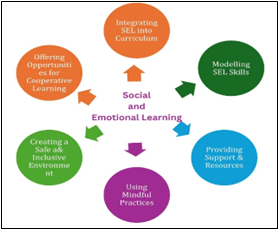
Image: Strategies for Implementing SEL in Classrooms
Source: Author’s compilation
Role of Educators in Social and Emotional Learning
- As educators, you need to integrate SEL into teaching-learning processes through daily lessons and activities where discussions about emotions, relationships and ethical decision-making can be taken up.
- The teachers may demonstrate empathy, active listening and effective communication that can set a powerful example for the students to follow. Besides, the classroom culture should be established in a way that promotes respect, inclusivity and a sense of community.
- The teacher should encourage the students to express their thoughts and feelings openly and provide platforms and opportunities where they can collaborate and support each other. During recent times, especially after the COVID phase, increased attention has been given to mindfulness exercises, including deep breathing, meditation and reflective journaling. Using such strategies may also help students develop emotional regulation and self-awareness skills.
- The teacher can also engage students in some group activities that involve working in teams so that problem-solving skills and communication can be improved. The students undergo a variety of problems related to personal (emotional or social), academic, adjustment, and career aspects, hence the teachers must provide them access to proper and directed counselling services and other support by encouraging open communication to address the concerns.
In this entire process, the role of parents can not be subsided. The efforts taken by the teachers in the classroom must be reinforced by parents at home. The collaboration between the school and family is quite essential for the successful implementation of SEL strategies. There should be regular active communication between the school, teachers and parents so that the school-home relationship can be strengthened. This ensures that the students receive the consistent support required for their social and emotional development.
Role of Parents in Social and Emotional Learning
Where the teachers provide a safe space for development at school, the parents should incorporate similar practices at home by encouraging open communication and teaching empathy.
- Parents should attend to their child’s emotional needs and offer proper guidance and support.
- The parents should also serve as role models for their children by demonstrating positive behaviour, empathy and effective problem-solving skills and most importantly they should create a supportive and loving home environment which may include family time for sharing their feelings, experiences, joys and problems.
How does K.R. Mangalam University Promote Social and Emotional Learning?
K.R. Mangalam University places a strong emphasis on holistic education, which includes the promotion of Social and Emotional Learning (SEL). This approach is integral to fostering well-rounded individuals who are not only academically proficient but also emotionally intelligent and socially responsible.
KRMU integrates SEL into the curriculum through various subjects and courses and offers robust counselling services to support students’ mental health and emotional well-being. K.R. Mangalam University’s commitment to Social and Emotional Learning is evident through its comprehensive approach that includes curriculum integration, support services, and a variety of extracurricular and community activities. By prioritizing SEL, KRMU prepares students not only for academic success but also for personal and professional fulfilment in a diverse and dynamic world.
Conclusion
In a nutshell, by promoting a sense of belonging in the classrooms as well as at home, encouraging free expression among students, and recognizing the warning signs of their mental health needs, a teacher and the parents can foster an environment that nurtures success in studies and helps the students grow to face the challenges of life throughout their lives. By integrating the above-mentioned SEL into our educational as well as regular practices, we can work towards creating a supportive and inclusive environment where the students can thrive academically, socially and emotionally.
FAQs
Here are some frequently asked questions to social and emotional learning:
What is Social and Emotional Learning (SEL)?
Social and Emotional Learning (SEL) is the process through which students develop skills like self-awareness, emotional regulation, empathy, and effective communication.
Why is SEL important for students?
SEL helps students manage emotions, build positive relationships, make responsible decisions, and perform better academically.
What role do teachers play in promoting SEL?
Teachers create a supportive classroom environment, encourage open communication, and identify students’ emotional needs to guide them effectively.
How does KRMU promote Social and Emotional Learning?
KRMU integrates SEL through interactive learning, community activities, and a supportive environment that nurtures both personal and professional growth.




 13 Schools700+ Faculty Members












 13+Years of Educational Experience