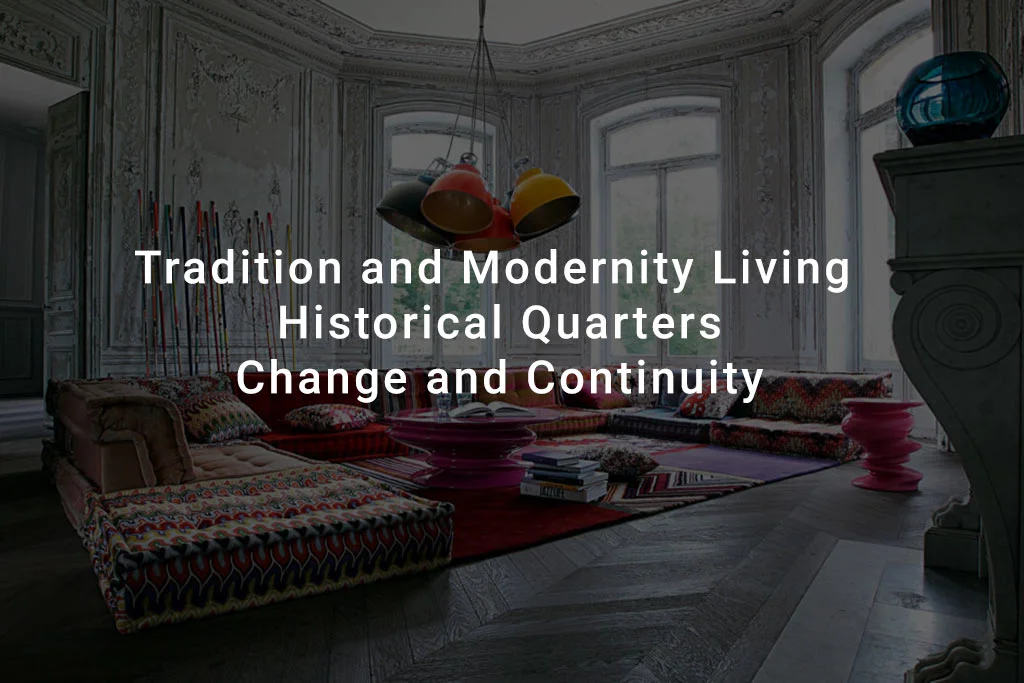
Many cities of the world have been in existence for centuries. Some of these cities exist today as the old towns or Living historical quarters of larger contemporary cities. These areas where the historical morphology is juxtaposed by the current pattern of life have transformed continuously to survive centuries of change. In this constant process of change and adaptation, the present is often an amalgamation of not only morphological and spatial identities but also of the living culture.
Old Delhi
“Delhi has well been described as the Indian Rome”.
Delhi has been an important historical city with its origins dating back to 1450 BC. It witnessed Buddhist and Hindu periods before entering a long phase of Islamic dominance. Historically Delhi is identified by the seven cities (1).
- Lal Kot founded and developed by Qutb ud din Aibak and his successor Iltutmish after 1192 when the Turkish invaders occupied Delhi.
- Siri founded by Alauddin Khalji (1296 – 1316) near Lal Kot.
- Tughlaqabad founded by Ghiyasuddin Tughlaq after succeeding the Khaljis in1320.
- Jahanpanah (world’s refuge) was founded between Lal Kot and Siri by Muhammad Tughlaq(1325 – 51)
- Firozabad was the fifth Muslim seat at Delhi founded by Firoz Shah(1351 – 88).
- Dinpanah became the first Mughal capital at Delhi which Humayun built between 1530 and 1540.
- Shahjahanabad founded by the Mughal emperor Shahjahan in 1638.
The founding of a new city was the traditional way of earning political immortality for a monarch or a dynasty. Delhi is thus dotted with the remains of many of its historical cities that exist today as individual or collection of monuments. But the superimposition of current life on a historical setting is clearly evident in the city of Shajahanabad which is today called Old Delhi or the walled city. This living historical city has witnessed 350 years of history and exists today as a bustling wholesale and retail commercial hub.
The dense organic pattern of Shahjahanabad was a response to the climate, resources, materials and the existing social, functional and spatial needs of the 17th century. The interventions and transformations that followed have continued to change the cultural and spatial layers of the city.
A brief description
The historic city of Shahjahanabad was founded by Emperor Shahjahan in 1638. It was built on the banks of river Yamuna. Shahjahanabad was planned during the heyday of the Mughal dynasty when Islamic architecture had reached its zenith..
Capitals of powerful dynasties like the Mughals, were the ‘axis mundi’(center of the earth and the intersection of the celestial and the mundane) (Blake: 1991). The designed infrastructure of the city included the fort (Red Fort), the Friday mosque (Jama Masjid) and other major mosques, the two main boulevards (Chandni Chowk and Faiz Bazaar), the elaborate system of water channels, some of the major gardens and the enclosing city wall with city gates. Shahjahan allocated the land around the fort to nobles for their palaces and mansions. The rest of the city was left to individual development.
The palace fort, occupied a position of great importance standing at the point of intersection of the 2 boulevards. River Yamuna flowed adjacent to the rear wall of the fort giving it natural protection. The Friday Mosque, Jama Masjid stood higher on a hillock and was a majestic structure visible from all parts of the city including the fort.
The principal artery divided the city into two unequal halves with the northern half being less densely populated with open spaces and public gardens and baths. The south western half was more densely populated. This artery was the main bazaar that later came to be called Chandni Chowk (moonlit square). The other boulevard was Faiz Bazar which ran perpendicular to Chandni Chowk.
Old Delhi today
Since the time of its inception the city fabric has undergone several transformations. The major causes of these transformations have been the invasion and massacre by the Afghans followed by the colonial rule. Later the first war of independence, introduction of railway line and the transfer of colonial capital from Calcutta to Delhi also contributed to the transformation.
The biggest change was due to the massive relocation of population after independence in 1947.This resulted in outflow of Muslim population to Pakistan and influx of Hindus and Sikhs into the city.
Due to the massive population growth after 1947 there was dramatic aggravation of urban problems in Old Delhi in the1950’s. After the introduction of railway line in 1867, Delhi had become the junction for routes from all over the subcontinent and hence the distributing centre for all merchandise (Gupta:2006) There was a drastic increase in the commercial activity. With the influx of massive population from Pakistan every opportunity to earn a livelihood was grabbed at and buildings were occupied and used for all sorts of businesses irrespective of their original function (Ehlers, Krafft:2003). Also wholesale trade replaced all the cultural and administrative activities of the city. In the last few decades Old Delhi has experienced a dramatic increase in commercial activities, especially in wholesale trade……. More than 50% of Delhi’s wholesale enterprises are located in the congested central bazaars of Old Delhi. (Krafft:2003: 105))
Thus began a period of uncontrolled commercialization and unplanned growth which further led to congestion and out migration of the original residents to better planned neighbourhoods of New Delhi.
The present day development of Old Delhi is characterized by commercial encroachment into traditional residential quarters and the transformation of historical structures. Almost all areas are threatened by the demand for commercial and storage space). This includes even the historically significant structures of the city which are endangered by misuse, deficient maintenance or real estate speculation.
Cultural Heritage
Jyoti Hosagrahar notices that the inhabitants of a place do not see themselves or their built forms as traditional as they live their daily lives amidst buildings and streets that may be old or evolved from the accumulated knowledge of generations. In their interpretation of received forms, uses and meanings, in the destructive/ creative upheaval of modernity, the residents may see no reason for orthodoxy either in romanticized preservation or in a complete rejection of existing forms”. This indifference of the users is perhaps because ‘the issues involved in monumental and historic conservation are not strictly speaking those of preserving inner city neighbourhoods for their residents’.
In the context of living historical quarters this relationship to the lived time and memory exists in a number of locations and practices. While the public spaces and buildings get adequate protection, what happens to the private residential structures and dwellings where present life and past morphology continue to produce amalgamated forms to survive the centuries?
Aylin Orbasli in her book, Tourists in Historic Towns mentions, “Although an underlying spatial morphology and a certain amount of the physical fabric are of a past era, the experience is of a contemporary heritage town in which layers of history in the urban fabric, use of space and contemporary human life interact, both in harmony and in tension”. While the historical city has continued to respond to the changing times, the underlying fabric was designed for a specific time period. These areas are constantly in use and the usage is rarely in accordance with the function they were meant for. Moreover, “these historic towns were not built to accommodate many modern day inventions including electricity, centralized services and the motor car. Inhabitants’ demands for better amenities, from indoor bathrooms and running water to cable television and car parking facilities have had an impact on historic areas”.
Thus the lived city which is rooted in a place and cultural context is constantly battling between transformation and familiarity. The historical quarter is a continuous recording of different time periods and a picture at any given time is a reflection of the then existing social, political and economic circumstances. The primary concern is the understanding of what should remain unchanged and why in this constantly molding environment. Consequently what should change to accommodate a different time frame and how much to mould is also a concern. In such a situation what needs to be preserved and what needs to continue to change is the dilemma.
In the developing world today, the historical cities are faced with this dilemma even more critically due to the mounting pressure for growth and development.
Understanding historical context and its continuity in the present is of great significance. Through site visits, course work and project work, these underlying concepts of historical continuity and the dilemma of tradition and modernity can be addressed.
Article Written By:-
Hemani Singh,
Professor,
School of Architecture and Planning,
K. R Mangalam University.
















 13+Years of Educational Experience