You just completed your 12th, you know somewhere deep down that teaching is what you want, and then everyone around you says the same thing: do B.Ed. after graduation, get a government job and become a teacher, lecturer or professor. Sounds nice and easy, right? But there is another version of this journey that only a few people know about. It is smarter, faster, and even more rewarding, and most students overlook it without a second glance. We’re talking about the B.El.Ed. course, which stands for Bachelor of Elementary Education.
It is one of the most purposeful undergraduate degrees a student can pursue directly after 12th grade. It is a four-year professional programme specifically designed to prepare graduates to teach children at the elementary level from class 1 to 8 with genuine pedagogical depth, psychological understanding, and classroom-ready skills.
This blog will walk you through everything you need to know about this course. It includes B.El.Ed. course details, eligibility criteria, the admission process, and what your career can look like on the other side of this degree.
So, let’s get started.
What is a B.El.Ed. Course?
Have you ever wondered why so many trained teachers still struggle in a real classroom? The answer isn’t easy to hear. Most teacher-training programmes in India prepare graduates to know their subject, not how to teach it.
There is a huge, often invisible difference when it comes to understanding a subject and knowing how a child’s brain processes it or simply how or what the child thinks while learning. The B.El.Ed. course at K.R. Mangalam University has been meticulously designed to close this gap.
Developed under the framework of the National Council of Educational Research and Training (NCERT), B.El.Ed. is a four-year undergraduate programme that combines subject knowledge with deep, structured teacher training. During the course of the programme, you will learn about:
- Child Psychology
- Pedagogy
- Language Development
- Classroom Management
- School Internships and much more.
This programme compiles all the subjects in the curriculum into a package which is genuinely cohesive. Over time, you develop a strong understanding of elementary teaching and gain hands-on classroom experience. Most importantly, you graduate knowing how children actually learn and how to teach them more effectively and efficiently. So, this is what this course is all about. Now, let’s have a quick overview of the programme details.
Also Read: Bachelor of Elementary Education: Top College, Skills, Scope
B.El.Ed. Course Details
Before moving further, let’s have a look at the factual details of the programme that will give you concise information:
| Particular |
Information |
| Name |
Bachelor of Elementary Education |
| Abbreviation |
B.El.Ed. |
| Course Type |
Undergraduate / Integrated |
| Duration |
4 Years / 8 Semesters |
| Mode |
Full-Time, On-Campus |
| Regulatory Body |
NCTE (National Council for Teacher Education) |
| University |
K.R. Manglam University, Gurugram |
| Annual Fee (as on May 2026) |
₹ 1,35,000 |
| Admission Mode |
Online | Entrance Test (KREE) |
Four years sounds very long. It is not when you consider that the alternative (a three-year graduation followed by a two-year B.Ed) costs you a minimum of five years and still leaves you less practically prepared than a B.El.Ed. graduate.
B.El.Ed. Eligibility – Who can Apply?
The eligibility criteria for B.El.Ed. course after 12th does not include very specific requirements. You do not need to have a specific stream or a specialised subject in your 12th marksheet. But you need to be equipped with these things to be eligible:
- Pass 10+2 in any stream equivalent to Science, Commerce, Arts or Humanities from a Government-recognised education board.
- Minimum 50% aggregate marks in your 12th marksheet. For students under reserved categories like SC, ST or OBC, this threshold goes down to 45%.
- English should be a mandatory subject in your 12th-grade marksheet.
- You must be at least 17 years of age as on 31st December of the year of admission.
And if your board results are still awaited? You can still apply. Provisional admission is extended to appearing candidates, though final confirmation depends on your declared results meeting the eligibility bar.
NOTE: Eligibility norms for B.Ed. Programmes are governed by the NCTE, and these norms can and do change over time. Before you submit a single document, verify the current requirements directly with the Admission Cell at K.R. Manglam University. Don’t rely on information available anywhere (except KRMU’s official website) online.
Why Choose K.R. Mangalam University for B.El.Ed.?
Modern Infrastructure
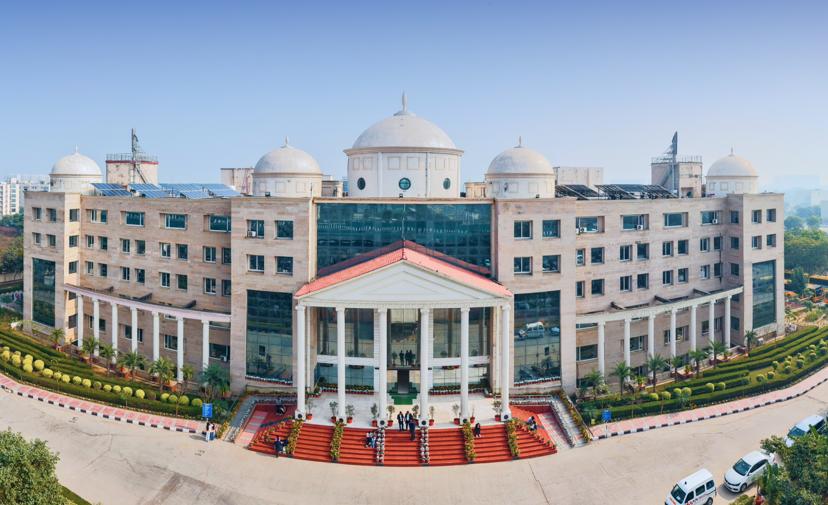
KRMU offers smart classrooms, advanced learning resources, digital labs, and interactive teaching spaces that create a practical and engaging environment for future educators to develop confidence, creativity, and effective classroom management skills.
Experienced Faculty
Learn from highly qualified faculty members with strong academic backgrounds and practical teaching experience who guide students through innovative methodologies, personalised mentorship, and hands-on training for successful teaching careers.
NEP-Aligned Curriculum
The B.El.Ed. programme at KRMU follows the National Education Policy, focusing on holistic learning, skill development, multidisciplinary education, critical thinking, and modern pedagogical practices required in today’s classrooms.
100% Placement Assistance
KRMU provides dedicated placement support through career counselling, interview preparation, internships, school collaborations, and recruitment drives, helping students secure rewarding opportunities in leading educational institutions and organisations.
How to Enrol in B.El.Ed. Course?
The B.El.Ed. admissions process at K.R. Mangalam University involves five simple steps:
Step1:
Fill out the application form right here.
Step 2:
Pay the registration amount and submit all required documents (ID proof, marksheets, etc.)
Step 3:
Appear for the entrance test, which is often followed by a faculty-led interview.
Step 4:
Wait for selection notification (results are out within 48 hours of the test).
Step 5:
Once selected, you’ll receive an admission offer.
Now that you know what a typical admission process looks like, let’s jump right into the career options after B.EL.Ed. course.
What are the Career Options After B.El.Ed.?
B.El.Ed. opens a lot of doors for primary school teachers, educators, program coordinators, and related roles. Additionally, you can also go for higher studies like a Master’s in Education, PG diploma in education management, etc. Besides this, you can also become:
- Education Counsellor
- Education Researcher
- Educational Technologist
- Curriculum Developer
- Education Administrator
- Education Consultant and many others.
B.El.Ed turned out to be one of the best degrees in the field of education. B.El.Ed. graduates often work with NGOs or Welfare Societies to support unprivileged children. The teaching profession not only shapes young minds but also becomes a meaningful journey filled with purpose, growth, and the opportunity to make a lasting impact on society.
Conclusion
If education is your passion, a B.El.Ed. course is one of the most meaningful and purposeful career paths you can choose after Class 12th. It doesn’t just hand you a teaching degree and send you into a classroom—it prepares you with the skills, confidence, and practical experience needed to become an effective educator. The degree also provides access to places people don’t immediately expect, not only inside classrooms, but in administrative roles too. It basically sits at the intersection of education and management without demanding a separate MBA to get there. This trait is pretty rare for an undergraduate programme in the country.
If this sounds like the path you’ve been looking for, don’t sit thinking over it for too long. Seats are limited, admission cycles move faster than most people plan for, and the students who act early are usually the ones who don’t have to scramble later. Apply NOW!
Also Read: B El Ed Course Details: Career & Job Opportunities
FAQs
What is the difference between B.El.Ed. and D.El.Ed.?
While both courses focus on preparing students to become elementary school teachers (classes 1 to 8), the difference lies in their duration and the depth of learning and curriculum. B.El.Ed. comprises 4 complete years, where you will study teaching with a blend of supporting subjects from the liberal arts.
On the other hand, D.El.Ed. is a 2-year vocational diploma programme that only focuses on primary school (Class 1 to 5) teaching, often pursued by students who want a quick route to becoming a junior school teacher.
Which course is best for a teacher?
It depends on the type of teacher you want to become. If you want to teach younger children at primary or elementary schools, you can pursue a B.El.Ed course. If you want to teach senior school children from classes 6-12, you can pursue a B.Ed.
What is the curriculum of B.El.Ed. course?
B.El.Ed. course compiles a blend of teaching subjects with subjects of the liberal arts. You learn about subjects such as:
Child Psychology
Pedagogy
Language Development
Classroom Management
School Internships and much more to become a successful teacher.
Which is best, B.Ed. or B.El.Ed?
Both courses are designed for different purposes. B.Ed (2-years) focuses more on teaching senior school students, typically classes 6 to 12th and requires graduation to pursue. However, B.El.Ed course (4 years) is specifically designed to teach junior school from class 1 to 8th and can be pursued directly after 12th.
So, the best choice depends on what kind of teacher you want to become, either a primary, elementary or secondary school teacher.
What is the starting salary of a teacher in India?
In India, the salary of a teacher depends upon several factors, such as:
Qualifications (The higher the qualification, the higher the salary)
School Type (Government schools pay better than an average private school)
Location (Teachers at education hubs such as Dehradun, DelhiNCR, Mumbai, Chennai, etc., earn more than in tier 2 or tier 3 cities)
In essence, the average starting salary of a teacher in India typically ranges between 2.5 LPA and 8 LPA, heavily depending upon the above-mentioned factors.
















 13+Years of Educational Experience