Physics is the foundation of all modern scientific and technological advancements, such as nanotechnology, artificial intelligence, etc. There are students who love physics and want to make a career in it. For them, B.Sc. Hons Physics is one of the best undergraduate courses. The demand for physicists, researchers, and technology experts has been increasing. Due to this reason, the search for the best BSc Hons Physics colleges in India is growing every year.
In this blog, we will explore what the programme covers, the admission process, and the career scope. Also, we will discuss the ways to find the top BSc Hons Physics colleges in India.
Quick Glance At The Blog
Below is a concise, tabular overview that summarises the complete information on B.Sc. (Hons) Physics, admissions, top colleges, career scope, and salary in a structured and easy-to-read format. In short, it is a summarised version of the information provided in the blog.
| Particular |
Details |
| Eligibility |
10+2 with Physics & Mathematics (50–60% minimum, varies by college) |
| Duration |
3 years (4 years with Research option – NEP aligned) |
| Course Focus |
Fundamental & applied physics, real-life applications in technology, space, energy, and research |
| Career Prospects |
Teaching, research, laboratories, IT, data science, government sector |
| Key Factors for College Selection |
Research projects & internships, Modern laboratories, Experienced faculty, Industry & research tie-ups, Placement & career guidance |
| K.R. Mangalam University (KRMU), Gurugram – One of The Best Colleges for BSc Hons Physics in India |
KRMU is among the leading B.Sc. (Hons.) Physics colleges in India, offering an industry-focused programme aligned with the NEP. Students can choose between a 3-year degree or a 4-year honours with research, covering key areas like mechanics, quantum physics, and electronics, ensuring strong theoretical knowledge along with practical skills. |
| Career Scope |
Research Scientist, Academics, Optics & Photonics Engineer, Data Scientist / Analyst, Software Developer / ML Engineer, Government & Public Sector |
About B.Sc. (Hons) Physics
B.Sc. (Hons) Physics is a 3-year undergraduate programme (4 years with research). The B.Sc (Hons) Physics programme is designed for students who are curious about how everything works in a scientific manner. In this, students not only learn theories, but also understand how physics is applied in real life—whether it’s in technology, space, energy, or research. This course also builds a strong foundation for higher studies like M.Sc or PhD. It also opens doors to careers in teaching, research, laboratories, and various science-driven industries.
Also Read: Know Everything About B.Sc. Physics
BSc Physics Admission in India
BSc Hons Physics colleges in India have their own admission rules, but still, the process is almost the same:
Eligibility Criteria
- Completed 10+2 with physics and mathematics.
- Many colleges require a minimum percentage (usually 50%–60%).
- While some universities provide merit-based admission, others administer entrance tests.
Documents Required
- 10th & 12th marksheets.
- Transfer/character certificate.
- Entrance scorecard (if applicable).
- ID proof & passport-size photos.
Tips for Admission
- Aspirants should apply early to avoid seat shortages.
- They need to research the syllabus and laboratory facilities.
- They should check whether the university offers internships or research projects.
- They should prefer those colleges that have the best science departments and placement support.
Top BSc Hons Physics Colleges in India
India has many reputed universities that are known to offer high-quality physics education. When choosing among the top BSc Hons Physics colleges in India, students need to consider the below-mentioned factors:
- Opportunities for research projects, papers, and internships.
- Modern laboratories & experimental equipment.
- Experienced professors and PhD-level faculty.
- Collaborations with scientific organisations.
- Campus placements and career guidance.
Best Colleges for BSc Hons Physics in India
Here’s a list of 10 of the best BSc Hons Physics colleges in India:
K.R. Mangalam University (KRMU), Gurugram – One of The Best Colleges for BSc Hons Physics in India
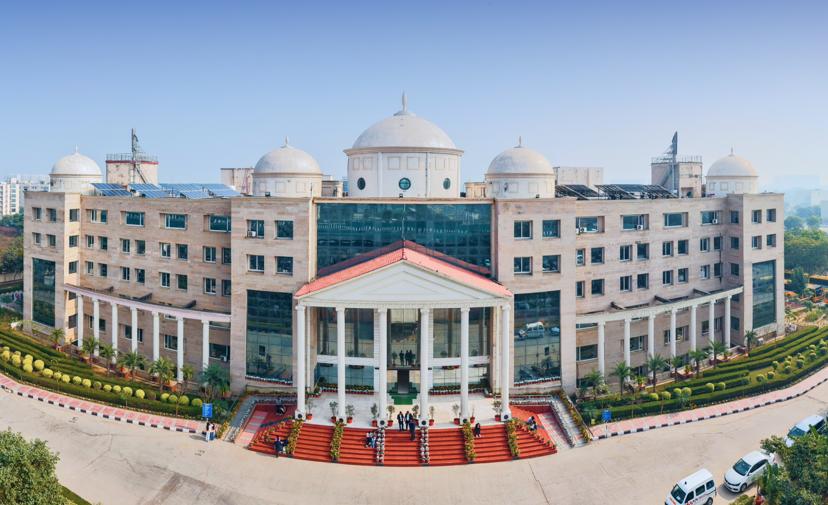
KRMU is one of the BSc Hons Physics colleges in India. This is because it provides an industry-focused B.Sc. (Hons) Physics programme. This programme is completely in line with the New Education Policy (NEP). Depending on their professional objectives, students can select either a 3-year degree or a 4-year honours with research option. This programme covers important topics including mechanics, quantum physics, and electronics. All of this guarantees both practical skills and a solid theoretical understanding of this subject.
Why it stands out:
- Experienced faculty
- Modern physics labs
- Research projects and internships
- Strong emphasis on practical learning
- Personal career guidance and placement cell
- Skill development in coding, data analytics, and problem-solving
Here, students get preparation guidance for JAM, GATE, NET, M.Sc. admissions, and research internships.
B.Sc. (Hons) Physics at KRMU
KRMU is one of the emerging choices among students searching for BSc Hons Physics colleges in India. The programme focuses on analytical skills, experiential learning, and research exposure.
Syllabus of B.Sc. (Hons) Physics at K.R. Mangalam University.
Year 1
| Semester 1 |
Semester 2 |
| Mathematical Physics-I |
Mathematical Physics II |
| Electricity and Magnetism Lab |
Waves and Oscillations Lab |
| Data Exploration & Analysis using Excel |
Cyber Security |
| Mechanics |
Documentation using Latex |
| Electricity and Magnetism |
Waves and Oscillations |
| Environmental Studies |
Minor |
| Instrumentation and Physics Workshop Skills |
Open Elective |
|
Minor |
|
Project-I |
|
Club/Society |
Year 2
| Semester 3 |
Semester 4 |
| Mathematical Physics-III |
Optics |
| Solid State Physics Lab |
Optics Lab |
| Open Elective II |
Electromagnetic Theory |
| Solid State Physics |
Modern Physics |
| Minor III |
Minor |
| Artificial Intelligence |
Open Elective |
| Project-II |
Project-III |
| Community Services |
Communication & Personality Development |
| Evaluation of Summer Internship I |
|
Year 3
| Semester 5 |
Semester 6 |
| Thermodynamics and Statistical Mechanics |
Digital Systems and Applications /Physics of Earth |
| Analogue Systems and Applications/ Applied Optics |
Analogue & Digital Systems Lab/ Physics of Earth Lab |
| Classical dynamics |
Quantum Mechanics and Applications |
| Nuclear Physics |
Research Methodology |
| Minor |
Hands-on in Robotics with Arduino |
| Arithmetic Reasoning and Skill-III |
Minor |
| Evaluation of Summer Internship II |
Project-IV |
|
Professional Employability Lab |
Year 4
| Semester 7 |
Semester 8 |
| B.Sc.(Hons. with Research) Physics |
B.Sc.(Hons. with Research)Physics |
| Atomic and Molecular Physics-I |
Atomic and Molecular Physics-II |
| Data Analysis and Research Report Writing Tools |
Minor EVS/DS/AI&ML |
| B.Sc.(Hons.) Physics |
B.Sc.(Hons.) Physics |
| Advanced Quantum Mechanics |
Atomic and Molecular Physics-II |
| Nanotechnology/ Fabrication of Electronic Devices |
Research Project |
| Advanced Quantum Mechanics |
Advanced Solid-State Physics |
| Minor |
Minor EVS/DS/AI&ML |
| Atomic and Molecular Physics-I |
Dissertation |
| Minor |
|
| Mathematical Methods of Physics |
|
Career Scope After B.Sc. Hons Physics
Here are the career opportunities for getting a degree from BSc Hons Physics colleges in India:
Research Scientists
Physics graduates are known for their ability to think critically, analyse complicated systems, and solve problems. These skills are highly valued in both existing and developing job markets. A research scientist’s job is to:
- Develop new technologies
- Conduct research
- Find solutions to difficult technical problems
Academics
Academics may be a good career choice if you enjoy instructing and inspiring the next generation of scientists. After earning an MSc or PhD, you can apply for teaching positions at colleges or universities. Future scientists and researchers are greatly influenced by physics instructors and professors.
Academics often engage in research and publishing in addition to teaching. A career as a professor is respected and fulfilling, even if it may take years to build.
Engineers in Optics and Photonics
Optics and photonics is another exciting and specialised field for BSc Physics grads. The study of light and its uses in industries, including entertainment, healing, and communication, is the focus of this area. For a variety of uses, optical engineers create and develop lasers, optical equipment, and other light-based technology.
Talented engineers who understand the properties of light and how to apply them practically are sought by telecommunications, medical imaging, and industrial companies.
Data Scientists
Becoming a data scientist or analyst is one of the highest-paying and fastest-growing employment options after earning a BSc in physics. Graduates in physics often have excellent mathematical, statistical, and problem-solving abilities—all of which are critical for data science. Working with big data, building predictive models, and producing insights that inform business choices are all part of the job description of a data scientist.
You may apply for employment in industries including advertising, technology, health, and finance. As data is becoming more and more important in decision-making, data scientists are in high demand.
Soft Developers and Engineers
The technology industry is currently one of the top employers for physics graduates due to the industry’s fast growth. Physicists are highly sought after in fields such as artificial intelligence, machine learning, and software development. You would have acquired strong programming abilities during your BSc Physics study, which are necessary for these roles.
You may easily transition into software development or machine learning engineering by learning new programming languages and technologies. The IT sector offers excellent pay, employment security, and growth prospects.
Jobs in the Public Sector and Government
For graduates in physics, the government sector offers a wide range of professional opportunities. Government research institutes, the defence sector, the energy sector, and space agencies like ISRO are all possible places to work. These jobs frequently include promoting the country’s science and technology and working on creative projects.
Salary Range of These Jobs
Overall salary range after computing the studies from BSc Hons Physics colleges in India:
For Fresh Graduates:
Rs 2.5 LPA – Rs 6 LPA (average starting range)
This applies to teaching, lab technician roles, research assistants, junior analysts, entry-level corporate roles, etc.
After 2–5 years of experience:
Rs 6 LPA – Rs 12 LPA
With skill development (data analysis, coding, research tools), salaries increase faster.
With higher studies (M.Sc, M.Tech, PhD, and data science courses):
Rs 10 LPA – Rs 25+ LPA
Students entering research labs, analytics, government scientific institutes, or IT roles earn significantly more.
Abroad (after M.Sc/ PhD):
Rs 25 LPA – Rs 1 crore+ (depending on country & industry)
Conclusion
Innovation, research, technology, and scientific discovery are all made possible by the potent area of physics. The first step to a prosperous career is selecting the BSc Hons Physics institutes in India. Students should look for modern labs, experienced mentors, research exposure, and strong placements when selecting the best colleges for BSc Hons Physics in India.
K.R. Mangalam University offers a robust environment for students to develop both academically and professionally in the subject of physics. It does this through an updated curriculum, hands-on laboratory instruction, and industry exposure.
Also Read: Scopes and Career Options After BSc in Physics Honours
FAQs
Why is KRMU considered one of the best B.Sc. (Hons.) Physics colleges in India?
KRMU stands out for its industry-oriented curriculum aligned and strong focus on both theoretical and practical learning.
What is the eligibility for admission to BSc Hons Physics colleges in India?
Most BSc Hons Physics colleges in India require students to complete 10+2 with Physics, Chemistry, and Mathematics. Some colleges ask for entrance exams, while others offer merit-based admission.
How much does it cost to study at top BSc Hons Physics colleges in India?
The fees vary depending on whether the student joins a government or private college. On average, BSc Hons Physics fees in India range from ₹30,000 to ₹2,00,000 per year in most private universities.
What subjects are taught in BSc Hons Physics colleges in India?
Students study Mechanics, Electromagnetism, Quantum Physics, Optics, Electronics, Mathematical Physics, Thermodynamics, Waves, and practical laboratory courses.
























 13+Years of Educational Experience