Today’s education is more than just memorising theories, lectures, and texts. Schools, universities, and even online courses now focus on what a student actually learns, not just what a teacher teaches. This shift has increased the importance of learning outcomes. It is a concept widely used in modern education, skill-based programmes, and professional training.
This blog explains what are learning outcomes, their examples, types, and how they differ from learning objectives, along with their importance in effective learning.
What are Learning Outcomes?
Learning outcomes are the information or abilities that students should have by the completion of a specific assignment, class, course, or programme. They help students:
- To recognise how such abilities and information will benefit them
- To emphasise the context and possible uses of knowledge and abilities
- To link education in a variety of settings
- By guiding them in directing review and assessment
Applying and integrating information is a key component of good learning outcomes. They describe how students will be able to use the material, both within and outside of the classroom, rather than concentrating on content covered.
Why are Learning Outcomes Important in Modern Education?
Learning outcomes play a key role in improving the quality of teaching and learning. Let’s explore how.
Benefits for Students
- Students are more engaged with their learning and the course material when they concentrate on applying the knowledge and skills they have learnt in the course and integrating them with other aspects of their lives.
- The focus on integration and transferable abilities increases student engagement by assisting students in making connections across courses and other types of information.
- Students are aware of the requirements and objectives of their evaluation.
Benefits for Teachers
- Creating these outcomes enables them to consider the course material and its possible uses, concentrating on the information and abilities that will be most useful to their students both now and in the future.
- They indicate effective assessment techniques.
- They give teachers the ability to establish the criteria by which the course’s effectiveness will be assessed.
Benefits for Institutions
- When a teacher evaluates a specific course or unit in light of upcoming assignments and the curriculum overall, it helps create a cohesive curriculum within a decentralised institution and guarantees that students are ready for work and learning in the future.
- They emphasise the application and integration of learning, which enhances student engagement, reveals opportunities for interdisciplinary study, and offers guidance and support to students with a wide range of prior academic preparation. These practices reflect and support the university’s contemporary nature and priorities.
- In addition to establishing frameworks for evaluating courses and programmes, they may help with curriculum and programme design, spot gaps or duplication in programme offerings, and define institutional, programmatic, and instructional priorities.
Also Read: Discover The Role Of Artificial Intelligence In Education
Difference Between Learning Outcomes and Objectives
Although often used together, learning objectives and outcomes are not the same. Let’s understand how.
| Comparison Point |
Learning Objectives |
Learning Outcomes |
| Focus |
What teachers will teach |
What students will achieve |
| Measurability |
Not always measurable |
Always measurable |
| Orientation |
Teacher-centred |
Student-centred |
| Time |
Before teaching begins |
After course/lesson completion |
| Example |
“The teacher will explain persuasive writing techniques.” |
“Students will write a persuasive essay with correct formatting.” |
In simple words, ‘objective’ means ‘teaching goal’, and ‘outcome’ means ‘learning result’. Teachers plan objectives, but students demonstrate outcomes. This difference is important in professional education, where measurable results show whether teaching is effective.
Types of Learning Outcomes
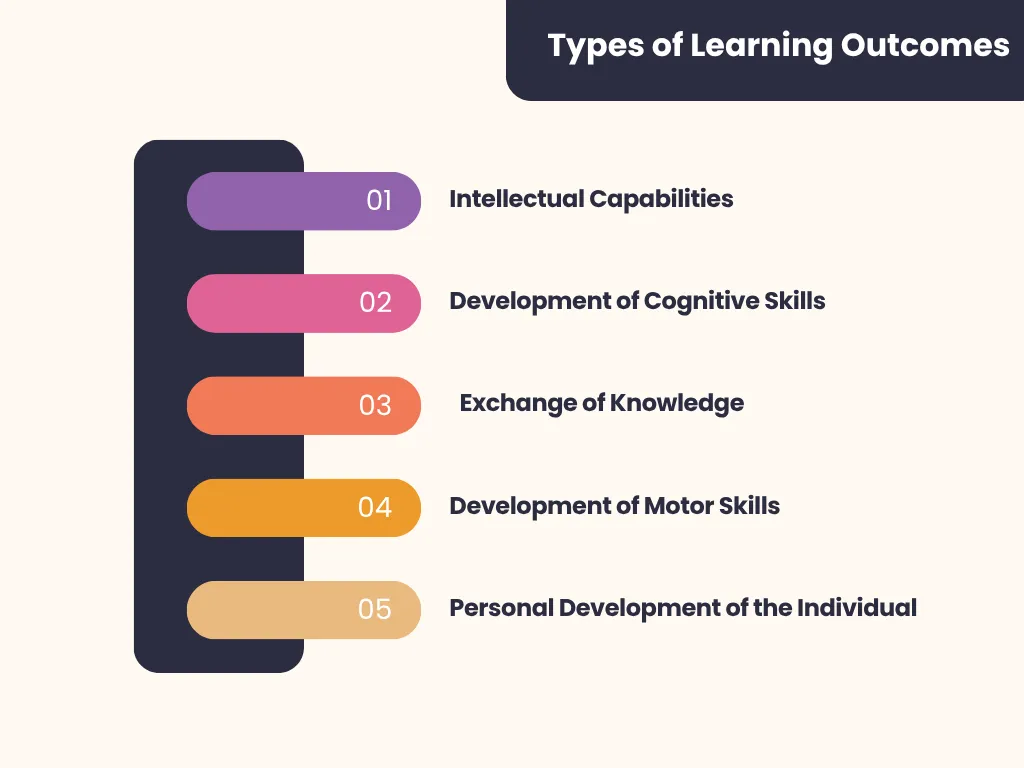
Given below are the different types of learning outcomes.
Intellectual Capabilities
To get the best learning results using this kind of learning outcome, students must be able to fully comprehend the subject. The fundamental learning result that is anticipated of a student is knowledge acquisition.
Development of Cognitive Skills
This learning objective pushes students to consider, evaluate, and fully comprehend the significance of a particular idea before acting appropriately.
Exchange of Knowledge
Students must be able to impart important knowledge to others. Students are therefore expected to develop a value system of knowledge by first acquiring it and then disseminating it to the world as part of this learning objective.
Development of Motor Skills
Enhancing a student’s capacity to plan and execute appropriate physical actions is the focus of motor skill development. They have to strive for their physical and general well-being.
Personal Development of the Individual
The internal state of the learner’s behaviour is reflected in this learning result. The ultimate level of learning is personal development in terms of knowledge, abilities, and capacity to produce something for society. The student must be able to manage their personal and professional lives and react appropriately to real-life situations.
The ultimate level of learning is personal development in terms of knowledge, abilities, and capacity to produce something for society. The student must be able to manage their personal and professional lives and react appropriately to real-life situations.
Learning Outcomes Examples
Let’s examine some actual examples of these outcomes from various tasks.
Task 1: A new hire onboarding course
Learning outcome: Students are able to recognise circumstances in which corporate policies are applicable and explain the appropriate course of action.
This outcome demonstrates that students comprehend and can remember new ideas, reflecting knowledge or intellectual abilities.
Task 2: A mediation seminar for HR officers
Learning outcome: Students can use dispute resolution techniques in actual work situations.
This outcome evaluates performance and shows if students are able to apply what they have learnt.
Task 3: A new product management software training session conducted online
Learning outcome: Students are able to use the programme and describe its features.
This result emphasises competency, demonstrating that students are capable of demonstrating a useful ability.
Task 4: A virtual reality training course on machine component replacement
Learning outcome: Students are able to insert and remove machine parts appropriately while providing an explanation of their actions.
This outcome emphasises a learner’s capacity to carry out activities physically and is related to motor skills.
Task 5: A talk about organisational tactics
Learning outcome: By describing concrete actions, students may show how they will apply organisational techniques.
This outcome deals with verbal knowledge and calls on students to express and apply what they have learnt.
These examples highlight that these learning outcomes make education practical, measurable, and skill-orientated.
How to Identify Positive Learning Outcomes
A well-written learning outcome focuses on what the student can demonstrate in a tangible way once they have finished the learning task. Only observable learning outcomes are beneficial. Therefore, it should incorporate the learner’s learning behaviours, the proper evaluation technique, and the particular success criteria.
Examples of strong learning outcomes:
- The ability of students to recognise the situations in which each of the five forms of conflict management should be used.
- Learners will be able to navigate and complete all training modules using the company’s LMS.
- Students will be able to analyse marketing data and make graphs with it.
- Students will be able to write SEO-optimised copy using the techniques recommended by the organisation.
- Students may appropriately develop case studies using industry requirements.
- The autoclaves can be cleaned and operated correctly by learners.
Examples of weak learning outcomes:
- Students will comprehend how to handle conflicts.
- Students will be familiar with the company’s LMS.
- Students will value the application of marketing data.
- Students will be aware of the business’s SEO strategies.
- Students will comprehend the components of a case study.
- Students will get knowledge about autoclaves.
To put it briefly, weak learning outcomes are ambiguous and challenging to evaluate, whereas strong ones are quantifiable and practical.
How to Create Learning Outcomes that Work for Every Learner
Whether you are in a classroom or a corporate environment, having explicit learning goals is crucial for effective training and education.
This is a methodical strategy for developing successful learning outcomes in many contexts, as mentioned below.
Determine the Learning Activity’s Goal
Make sure you understand the goal of the training session or class before determining results. The goal lays the groundwork for quantifiable results, whether it be skill development, compliance training, or the introduction of new ideas.
Describe What Success Means to Students
When creating a learning objective, consider what proficient students will be able to accomplish at the conclusion of the course or training. Consider observable behaviours. Will students be able to recognise, clarify, illustrate, or apply an idea, for instance?
Think About Several Forms of Education
Learning is more than just learning information by heart. Depending on the training or educational setting, learners may need to acquire physical skills, cognitive techniques, or intellectual abilities.
Make Sure the Results are Quantifiable
Effective results must be measurable via testing or observation. Can students successfully show their knowledge, do an assignment, or use a skill?
Align Results with Practical Uses
According to research, performance-based assessments—in which students use their knowledge or abilities in practical situations—are frequently more successful than standard knowledge examinations in gauging employee learning results.
Make results applicable by relating them to real-world applications. This guarantees that learning is useful outside of the classroom or training session and boosts engagement.
How Learning Outcomes Improve Effective Learning
Effective learning means students understand concepts deeply and can apply them—not just memorise. These outcomes directly support this by:
- Giving clear learning expectations
- Connecting teaching to real-life skills
- Making assessment more meaningful
- Helping students stay focused and motivated
- Allowing teachers to design better teaching strategies
For example, if a learning outcome says, “Students will create a multimedia presentation on climate change.”
It requires research, creativity, critical thinking, and communication—all key elements of effective learning.
Course Outcomes and Their Role
At the university level, every subject or course has a defined Course Outcome(s) (COs).
A course outcome explains what a student will achieve after completing the entire subject or semester.
Example of COs:
- Apply programming logic to solve real problems
- Understand marketing principles and apply them to case studies
- Conduct laboratory experiments and analyse results
Course outcomes ensure learning is job-orientated, practical, and aligned with industry requirements.
Teaching Objective
Teaching objectives guide teachers in planning lessons. They explain what a teacher intends to cover:
- Explain the chapter
- Introduce new concepts
- Conduct activities
- Provide notes and assignments
But the outcome shows whether these efforts worked. Teaching objectives lead to learning objectives, which in turn lead to learning outcomes.
Role of K.R. Mangalam University (KRMU) in Outcome-Based Education
Below are the points that show how K.R. Mangalam University ensures strong learning outcomes. The university offers:
- Industry-focused curriculum
- Practical training, labs, simulations, internships
- Project-based learning and real-world exposure
- Continuous assessment to check learning progress
- Faculty mentoring and skill development sessions
As a result, students don’t just learn theory, but they also gain practical knowledge, employability skills, communication abilities, and confidence for career success.
Conclusion
We have understood how and why learning outcomes are an essential part of modern education. They provide clarity, direction, and measurable achievements for both teachers and students. Whether in schools, universities, or corporate training, they ensure that knowledge turns into skills and learning leads to real progress. Students become more confident and goal-orientated, teachers plan better lessons and employers get industry-ready professionals.
With outcome-based learning, education becomes meaningful, skill-driven, and future-focused—and this is exactly what institutes like KRMU aim to deliver.
Also Read: What Is The Importance Of Inclusive Education
FAQs
Q1. What are learning outcomes?
Learning outcomes are measurable statements describing what a student will know or be able to do after completing a course or lesson.
Q2. What is the difference between learning outcomes and objectives?
Learning objectives are teaching goals, while learning outcomes are measurable results of what students actually learn.
Q3. Where are learning outcomes used?
Learning outcomes are used in schools, colleges, skill training programmes, online courses, and corporate training.
Q4. Why are learning outcomes important?
They improve teaching quality, student performance, and assessment.




 13 Schools700+ Faculty Members














 13+Years of Educational Experience