Choosing the right career path after completing high school can be a daunting task for every student, especially those who have pursued the science stream in their 12th. Students often find themselves overwhelmed with the wide range of options available and the pressure to make the “right” choice for their future. At this stage, understanding one’s interests, strengths, and long-term goals becomes crucial. It is also important to explore various fields, compare opportunities, and stay informed about emerging career trends before making a decision.
While medical and engineering courses are often the go-to options for students, there is a vast array of non-medical courses that offer promising career prospects. These fields open doors to diverse industries where students can build successful and fulfilling careers based on their passion and strengths.
Overview
| Sections |
Descriptions |
| Non-Medical Courses after 12th for Science Students |
Science students can pursue diverse non-medical options such as B.Sc. (Hons.) programmes, Engineering, BBA, Law, Architecture, Journalism & Mass Communication, etc. |
| Conclusion |
Non-medical courses provide wide-ranging career opportunities, and universities like K.R. Mangalam University offer industry-oriented programmes that help students build successful and fulfilling careers. |
Non-Medical Courses after 12th for science students
Science students who’ve finished Class 12 aren’t limited to medical courses, not by a long shot. Plenty of paths open up beyond that. B.Sc. specialisations wait on one side. Engineering sits nearby. Computer applications, architecture, management, law, hospitality, journalism, the list runs long. Eligibility shifts depending on a few things though. Subjects studied in Class 12 matters. Entrance exams factor in too. And whatever specific requirements a university or programme has laid out need checking as well.
B.Sc. (Hons.) Mathematics
B.Sc. Hons Mathematics suits a particular kind of student. Someone drawn to mathematics itself. Logical reasoning too, and the kind of quantitative problem solving that doesn’t come naturally to everyone. Depending on how the curriculum is structured, algebra shows up. Calculus does too. Probability, statistics, and geometry round things out. Once graduation hits, doors open in several directions. Education calls for some. Research draws others in. Finance and analytics pull in a different crowd, and for those wanting to go deeper, postgraduate study in mathematics or related disciplines remains very much on the table.
B.Sc. (Hons.) Physics
B.Sc.(Hons.) Physics is an ideal choice for students who are interested in the course. The course encompasses the study of classical and modern physics, quantum mechanics, electromagnetism, astrophysics, and theoretical physics. After the completion of B.Sc.(Hons.) Physics course students can employment opportunities in research organizations, educational institutions, government agencies, engineering firms, and industries related to electronics, aerospace, energy, and telecommunications.
B.Sc. (Hons.) Chemistry
B.Sc. (Hons.) Chemistry is one of the sought-after career options for students with a keen curiosity in the composition, properties, and transformations of matter. The programme comprises topics such as organic, inorganic, and physical chemistry, as well as analytical techniques and laboratory practices so that students can gain practical exposure to the course and solve real-life problems.
After graduation, they can work as Lab Assistant, Production Chemist, Water Quality Chemist, Product Officer, Research & Development Manager etc.
Engineering
Engineering is a vast area that includes using mathematical and scientific ideas to design, create, construct, and maintain numerous devices, systems, and processes. This is an excellent option for students who possess a knack for programming, problem-solving, and computational thinking offering specializations in engineering such as
- B.Tech CSE
- B.Tech CSE (AI & ML)
- B.Tech. Mechanical Engineering
- BCA (AI & Data Science)
- B.Tech. (Civil Engineering)
- B.Tech CEE
- B.Sc. (Hons.) Computer Science
- B.Sc. (Hons.) Data Science
- B.Sc. (Hons.) Cyber Security etc.
Bachelor of Architecture
Bachelor of Architecture programme prepares students for a career in architecture. It involves designing and constructing buildings and structures while considering aesthetics, functionality, and safety. Graduates will be able to work as Architect, Interior Designer, Architectural Assistant, Urban Planner, Project Assistant Manager.
Bachelor of Hotel Management and Catering Technology
A Bachelor of Hotel Management is an undergraduate degree program that focuses on building the skills and knowledge required for a job in the hospitality sector. Students gain a thorough understanding of the various aspects of the hospitality sector, guest services, food and beverage management etc.
Graduates with a BHMCT degree have a wide range of employment options, including a chef, front office manager, marketing manager, catering supervisor, catering assistant, and catering manager.
B.A. (Journalism and Mass Communication)
B.A. in Journalism and Mass Communication covers a broad range of topics, including media law, journalism ethics, news writing, multimedia storytelling, advertising, public relations, and media research. Students gain expertise in writing, interviewing, researching, editing, and media production through a combination of theoretical understanding and hands-on instruction.
The B.A. in Journalism and Mass Communication degree prepares graduates for careers in journalism, broadcasting, digital media, advertising, public relations, and other related fields.
BBA
A BBA undergraduate degree programme gives students a thorough understanding of several business and management-related topics. Travel and tourism, finance, marketing, human resources, international business, and entrepreneurship are topics covered in BBA courses. Students who complete this programme will have developed critical thinking, problem-solving, decision-making, leadership, and communication abilities.
BBA programme graduates have a wide range of job options, including positions in banking, consulting, marketing, sales, project management, human resources, and entrepreneurship. They can pursue positions in multinational corporations, start-ups, government organizations etc.
Law
A Law courses provides students with a comprehensive understanding of the legal system, principles, and practices. The curriculum typically involves theoretical study, case analysis, legal research, and practical training through moot court sessions or internships. Graduates can go for law courses like
- BBA LL.B. (Hons.)
- B.Com. LL.B. (Hons.)
- B.A. LL.B (Hons.)
- LL.B. (Hons.)
The course prepares students for a wide range of career opportunities such as lawyers, legal consultants, judges, legal researchers, or pursuing roles in government, Document drafting Lawyer, corporate firms, Legal Journalist, Legal Analyst etc.
KRMU’s Non-Med Course
K.R. Mangalam University (KRMU) offers a wide range of non-medical courses designed for students who want to pursue careers beyond the medical field. The university provides industry-oriented programmes across streams like Management, Law, Humanities, Design, Engineering, Commerce, Computer Applications, Hospitality, Education, and more. These courses are structured to give students strong theoretical knowledge along with hands-on learning, internships, workshops, and real-world exposure.
KRMU’s non-medical programmes are known for their modern curriculum, experienced faculty, state-of-the-art facilities, and excellent placement support—ensuring that students are well-prepared for professional success in their chosen domains.
Conclusion
Above is the List of Non-Medical Courses after the 12th that you can choose after your 12th. Every course is vast and offers various employment opportunities in reputed organisations or companies for students.
Choosing the right career path after completing high school can be a daunting task for every student, especially those who have pursued the science stream in their 12th. While medical and engineering courses are often the go-to options for students, there is a vast array of non-medical courses that offer promising career prospects.
This blog aims to shed light on Non-Medical Courses after 12th, providing insights into the world of non-medical courses and highlighting their significance in empowering students.
With its diverse range of programmes across management, law, humanities, design, engineering, commerce, hospitality, computer applications and more, KRMU ensures that every learner finds a path aligned with their interests and career goals. Due to this reason, it has become a preferred choice amongst many aspirants.
FAQs
What are non-medical courses after 12th for science students?
Non-medical courses are career options available to science students who do not wish to pursue medical fields, such as engineering, management, law, design, journalism, architecture, and science-based degree programmes.
Is B.Sc. non-medical a good option after 12th science?
Yes. B.Sc. non-medical courses like Mathematics, Physics, Chemistry, Computer Science, and Data Science offer strong career prospects in research, education, analytics, and industry roles.
Can science students pursue management courses after 12th?
Yes. Science students can pursue courses like BBA, which build strong foundations in business, management, leadership, and entrepreneurship.
Why should students choose KRMU for non-medical courses after 12th?
KRMU offers a wide range of industry-focused non-medical programmes with modern curriculum, experienced faculty, hands-on training, internships, and strong placement support.




 13 Schools700+ Faculty Members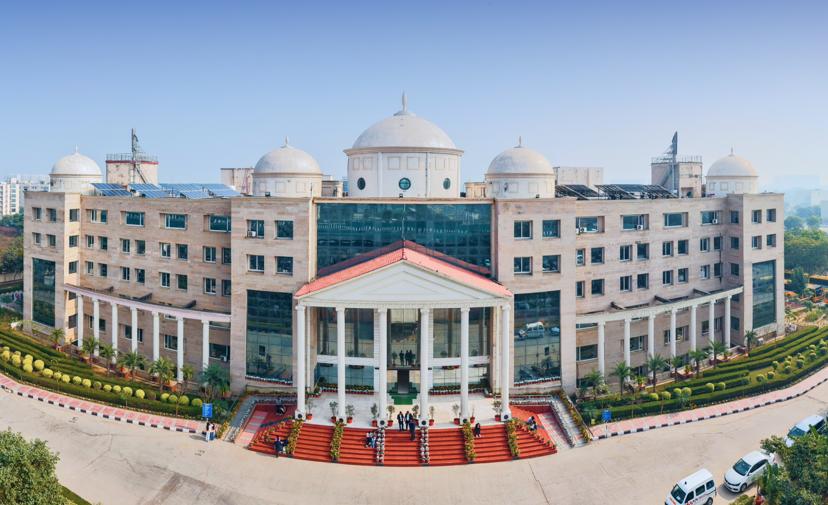













 13+Years of Educational Experience