Engineering is where innovation meets problem-solving to shape the future.
From artificial intelligence and electric vehicles to smart cities and renewable energy, engineering is driving the technologies that are transforming how we live and work. As industries increasingly adopt automation, digitalisation, and data-driven solutions, the demand for skilled engineers continues to grow across sectors.
Love solving problems? Curious about how things actually work under the hood? Then B.Tech is probably worth a serious look. It’s one of the more solid starting points for an engineering career, especially now that there’s so much more on offer than the old-school branches. Computer science and engineering, AI and Machine learning, full stack development, cyber security, data science, robotics & AI — the choices have genuinely multiplied, and picking the right one isn’t always straightforward.
That’s precisely why knowing the List of B.Tech Courses, along with where each one can take you career-wise, matters so much before you commit to a programme.
This blog explores the top B.Tech. courses and various other aspects related to them.
| Sections |
What Readers Will Learn |
| What Is B.Tech.? |
Understand what a Bachelor of Technology (B.Tech.) programme is, its duration, curriculum, and how it combines theoretical knowledge with practical learning. |
| What Are B.Tech Courses? |
Defines B.Tech courses and explains their technical, practical, and industry-orientated focus across different engineering specialisations. |
| Course Duration: 1-Year, 3-Year and 4-Year Options |
Explains the typical duration of different degree and professional courses, including the standard four-year duration of B.Tech programmes. |
| Why Should Anyone Pursue B.Tech. Courses? |
Discover the key benefits of pursuing a B.Tech., including technical knowledge, career growth, professional networking, essential skill development, and opportunities for higher education. |
| Why Are B.Tech. Graduates in High Demand? |
Learn how advancements in digital technologies, semiconductors, electric vehicles, and India’s digital economy are increasing demand for engineering professionals. |
| Exploring the List of B.Tech. Courses |
Explore popular B.Tech. specialisations such as computer science, mechanical, civil, etc. |
| Eligibility for B.Tech. Courses |
Understand the basic eligibility criteria, required subjects, minimum academic qualifications, and admission requirements for B.Tech. programmes. |
| Why Should Anyone Pursue B.Tech. Courses? |
Highlights the key benefits of pursuing a B.Tech., including technical knowledge, career opportunities, professional networking, skill development, and opportunities for further learning. |
| Which Is the Best Among B.Tech Courses? |
Explains how students can evaluate B.Tech specialisations based on their interests, strengths, career goals, curriculum, and future opportunities. |
| Why Choose K.R. Mangalam University (KRMU) for B.Tech.? |
Learn about KRMU’s industry-aligned curriculum, practical learning approach, modern infrastructure, experienced faculty, industry exposure, research opportunities, and placement support. |
| What Are the Best Career Options After B.Tech.? |
Discover career opportunities after B.Tech., including Software Developer, AI Researcher, IT Consultant, AI & ML Engineer, Cybersecurity Analyst, and other technology-driven roles. |
| Conclusion |
Summarises how choosing the right B.Tech. programme and university can help students build successful engineering careers in emerging technologies and innovation-driven industries. |
What Is B.Tech.?
B.Tech. stands for Bachelor of Technology. It’s an undergraduate degree. And it focuses on one thing above all: engineering, technology, and how these subjects work in the real world.
Most B.Tech. programmes run for four years. But if you’re a diploma holder, you might not need all four. Lateral admission lets you skip ahead and join directly into the second year, cutting your journey short.
What will you actually study? That depends entirely on your specialisation. Some students dive into computer science. Others chase artificial intelligence or data science, fields that are exploding right now. Then there’s cybersecurity, electronics, mechanical engineering, civil engineering — the list goes on, each opening a different door.
Classrooms alone don’t make an engineer, though. B.Tech. programmes know this. So, alongside lectures, you’ll spend hours in labs, work on real projects, and complete internships that put theory into practice. It’s messy sometimes. It’s hands-on, always.
And here’s the real value: you don’t just learn formulas and code. You learn to think analytically, solve problems on the fly, and work as part of a team — skills that matter just as much as your technical know-how once you step into a job.
What Are B.Tech Courses?
B.Tech (Bachelor of Technology) courses are undergraduate engineering programmes that provide students with technical knowledge, practical skills, and industry-orientated training in specialised fields such as Computer Science, Artificial Intelligence, Mechanical Engineering, Civil Engineering, Electronics, and more.
Course Duration: 1-Year, 3-Year and 4-Year Options
| Course Duration |
Typical Duration |
Examples |
| 1-Year Options |
1 year |
Certificate, diploma, or specialised programmes |
| 3-Year Options |
3 years |
Many undergraduate degree programmes |
| 4-Year Options |
4 years |
B.Tech, B.Sc. (Hons.), BBA, and other professional/undergraduate programmes |
Course duration varies by programme, university, and applicable academic regulations.
Exploring the List of B.Tech. Courses
The list of B.Tech courses has grown quite a bit. It isn’t just the traditional branches anymore; specialisations now follow what’s happening in the industry and where technology is heading. Think about computer science and engineering, artificial intelligence and machine learning, data science, cyber security, full stack development, and robotics & AI — all fairly in demand now. At K.R. Mangalam University, here’s what’s available for the 2026-27 academic session:
- B.Tech. Computer Science and Engineering
- B.Tech. Computer Science and Engineering (AI & ML) with academic support of IBM & powered by Microsoft Certifications
- B.Tech. Computer Science and Engineering (Full Stack Development) with academic support of ImaginXP
- B.Tech. Computer Science and Engineering (UX/UI) with academic support of ImaginXP
- B.Tech. Computer Science and Engineering (Cyber Security) with academic support of EC-Council and IBM
- B.Tech. Computer Science and Engineering (Data Science) with academic support of IBM
- B.Tech. Computer Science and Engineering (Robotics & AI) with academic support of IBM & powered by Microsoft Certifications
These programmes have a 4-year duration, while the corresponding lateral-entry programmes are offered over 3 years.
Eligibility for B.Tech Courses
Students must have passed their 10+2 examinations with a minimum of 50% of aggregate marks from a recognised board. Also, students must have had physics, chemistry and mathematics as core subjects in high school. Eligibility criteria often depend on the university/institution the candidate is choosing. Also, students can apply for admission based on marks scored in national or state-level entrance exams.
Why Should Anyone Pursue B.Tech. Courses?
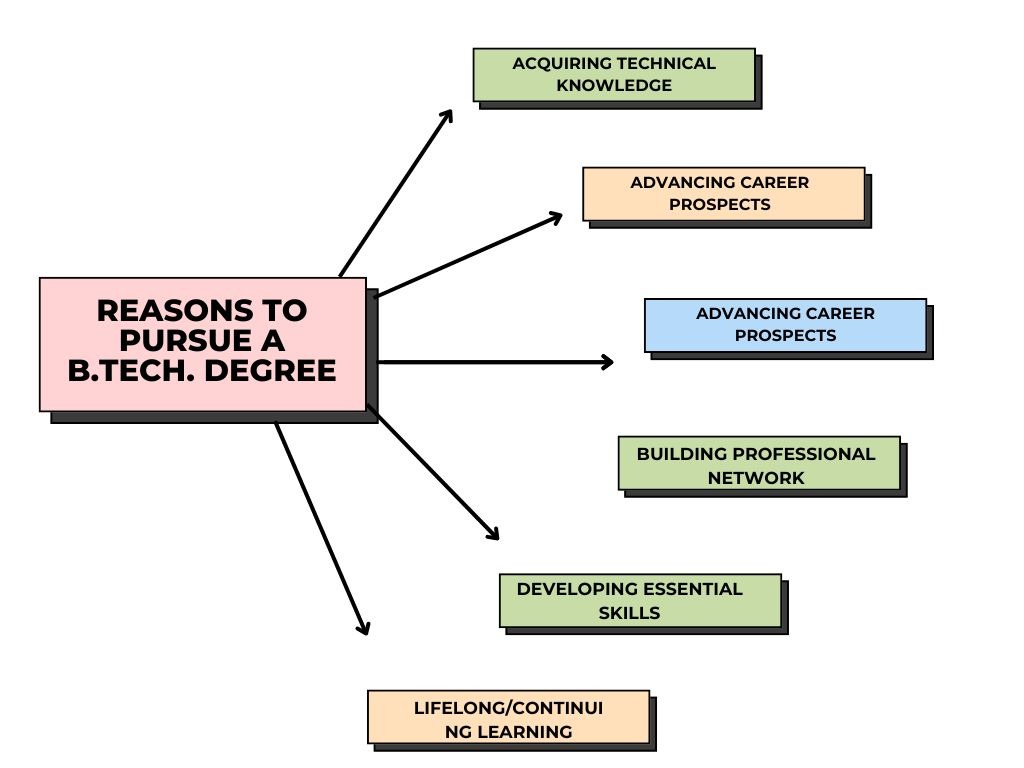
Earning a B.Tech degree holds a significant preference for aspiring engineers to make a positive impact on society. One of the major benefits of pursuing B.Tech. courses is that it helps students develop some invaluable skills to achieve their future goals. In addition, students will be able to advance their careers to meet industry demands. Below are the reasons that show why pursuing a B.Tech. course is a smart thing to do:

Acquiring Technical Knowledge
Students pursuing B.Tech courses acquire in-depth technical knowledge through a strict course curriculum which comprises both theoretical approaches and practical learning. Additionally, B.Tech courses assist students in becoming masters in learning core concepts of the engineering landscape and developing invaluable skills to excel in a technology-driven world.
Advancing Career Prospects
We all know that engineers are in high demand across various sectors. Every organisation needs skilled engineering professionals, leading to the excessive growth of individuals who are well-equipped with essential skills and knowledge. After graduating with this programme, students have a diverse range of career opportunities to work in various sectors with potential growth.
Building Professional Network
Building a professional network is necessary for advancing your career, as it opens doors to various opportunities. Through industry connections, students get to know current market trends and demands. B.Tech courses encourage students to participate in industry conferences or workshops to connect with technical experts.
Developing Essential Skills
Students learn to develop various essential skills throughout their course duration. B.Tech courses also develop problem-solving skills, critical thinking skills, technical skills, entrepreneurship skills, etc., helping students to convert their innovative ideas into impactful startups. These skills enable students to enhance their personal and professional growth in future.
Lifelong/Continuing Learning
After earning a B.Tech. programme degree, students can continue their further studies or apply for advanced learning. They can pursue a postgraduate-level engineering programme which not only enhances their technical understanding but also keeps them competitive in a rapidly evolving industry.
Which Is the Best Among B.Tech Courses?
There is no single best B.Tech course for every student. The right choice depends on interests, academic strengths, career goals, job opportunities, and preferred area of specialisation. Students should compare the curriculum, practical exposure, industry relevance, career scope, and future opportunities before choosing a B.Tech course.
Why Are B.Tech. Graduates in High Demand?
Engineering continues to be one of the most sought-after career choices because it offers opportunities across diverse industries, from information technology and manufacturing to healthcare, infrastructure, aerospace, finance, and renewable energy.
The growing adoption of digital technologies has further expanded the demand for engineering professionals worldwide.
According to recent industry reports:
- India’s digital economy is expected to become a US$1 trillion economy by 2027–28 and contribute nearly one-fifth of the country’s GDP by 2030.
- The Government of India has committed ₹76,000 crore under the India Semiconductor Mission to strengthen domestic chip manufacturing and electronics production.
- India’s electric vehicle market is expected to grow at over 40% CAGR through 2030, creating significant opportunities for engineers in emerging technologies.
These developments demonstrate why engineering graduates remain highly valued across industries.
Why Choose K.R. Mangalam University (KRMU) for B.Tech.?
KRMU is a well-known university that offers a variety of future-ready B.Tech. courses, which are:
Below are the reasons that make KRMU the most sought after for B.Tech programmes:
| Reasons |
Details |
| Industry-Aligned Curriculum: |
The B.Tech. curriculum is created in collaboration with professionals in the field and is in line with the most recent developments in technology. |
| Practical Learning Experience |
Learning occurs outside of the classroom through well-equipped labs, industrial projects, internships, mini-projects, and capstone projects. This practical approach allows students to apply theoretical concepts to real-world engineering challenges. |
| Learn from Experienced Faculty |
In order to ensure that classroom learning is in line with industry standards, students are mentored by seasoned academicians and business experts who blend academic knowledge with real-world insights. |
| Modern Infrastructure |
The institution offers cutting-edge computer labs, specialist engineering labs, smart classrooms, innovation-focused learning areas, and contemporary campus amenities that facilitate research and experiential learning. |
| Strong Industry Exposure |
Frequent workshops, seminars, internships, real-world projects, and partnerships with industry partners give students the chance to learn about modern workplace procedures and technology while improving their professional preparedness. |
| Placement and Career Support |
It provides industry interaction, career counselling, internship support, and committed placement aid. |
| Research and Innovation |
Research, innovation, entrepreneurship, and interdisciplinary projects that develop critical thinking, creativity, and problem-solving skills are all encouraged for students. |
What are the Best Career Options After B.Tech.?
Here are some of the best career options after B.Tech.:
Software Developers
The systems and programs that are common in today’s industries are created, tested, and maintained by software developers. With great development potential and good pay, this is one of the most dependable and sought-after positions for B.Tech CSE students.
AI Researchers
AI researchers create cutting-edge models and intelligent systems that power robots, generative AI, driverless cars, and voice assistants.
IT Consultants
IT consultants help businesses use the best technology to improve efficiency, security, and performance. This role is great for those who want to pursue careers in management since it blends technical expertise with strategic decision-making.
Artificial Intelligence (AL) & Machine Learning (ML) Engineers
AI/ML developers create intelligent systems with autonomous decision-making capabilities. ML engineers provide automation tools, chatbots, recommendation systems, and image recognition – some of the highest-paying positions after a computer science B.Tech.
Cybersecurity Analysts
Cybersecurity researchers find vulnerabilities and put preventative measures in place to protect companies from cyber attacks. Although cybercrime is increasing, cybersecurity offers a high level of job security.
Conclusion
A B.Tech. degree equips students with the technical knowledge, practical skills, and industry exposure required to succeed in today’s rapidly evolving engineering landscape. With a wide range of specialisations and career opportunities, choosing the right programme and university is the first step towards a successful future.
K.R. Mangalam University combines an industry-aligned curriculum, hands-on learning, experienced faculty, and strong industry exposure to prepare students for rewarding engineering careers.
Take the first step towards becoming a future-ready engineer—explore the B.Tech programmes at K.R. Mangalam University (KRMU) and build a career that drives innovation.
Also Read: B.Tech Computer Science Course: Eligibility, Syllabus, Exams, Fees, Scope
FAQs
What are the Eligibility for B.Tech Courses at K.R. Mangalam University?
To become eligible you must have Passed the 10+2 examination with Physics and Mathematics as core subjects in high school. For the remaining single course select any course from Chemistry/ Computer Science/ Electronics/ Information Technology/ Biology/ Informatics Practices/ Biotechnology/ Technical Vocational subject/ Agriculture/ Engineering Graphics/ Business Studies/ Entrepreneurship from any recognized Board/ University with a minimum of 50% aggregate marks.
How can I apply for the B.Tech Programme at K.R. Mangalam University?
If you are interested in applying for any B. Tech Programme at K.R. Mangalam University then you need to follow these steps thoroughly:
Fill up the online application form available on the official website
Pay the application fee online
Appear for KREE (K.R. Mangalam Entrance Exam)
Attend interaction with experienced faculty members
After successful interaction with faculty members, you’ll receive an admission offer.
Pay the whole fee
Are there any internship or placement opportunities for B.Tech Courses at K.R. Mangalam University?
Absolutely, there is a dedicated placement cell where students get trained nicely to meet industrial demands. Top tech companies pay their visits annually and provide placements to students.
What is the B.Tech Programme duration?
The duration of the B.Tech programme is 4 years of undergraduate degree divided into 8 semesters.
What are the Job Opportunities After Engineering after completing B.Tech Programmes?
The B.Tech. Programmes are among the top choices pursued by students around the world. Students after completing this programme can make their careers as Mechanical Engineer, Civil Engineer, Aeronautical Engineer, Aerospace Engineer, Marine Engineer, Computer Science Engineer etc.




 13 Schools700+ Faculty Members













 13+Years of Educational Experience